Monday, 27 April 2015

Artbrau 2015 - Part 1

2 comments
I'd read about Artbrau a few months ago, the latest craft beer festival for the German beer calendar, this time in Heilbronn, an hour's train ride away. But in the stress of moving house earlier this year, I completely forgot about it till my brother-in-law, Chris, phoned me to invite me to it as a birthday present. Living in Heilbronn, he'd heard it mentioned on local radio, and thought it'd be right up my alley.

I have to admit, when I first read about it, the similarity to Braukunst Live really struck me. Artbrau - Braukunst, the names of both playing on the art of brewing, but both also located in transport museums? The finest form of flattery, I guessed.

Looking at the website, the lineup seemed small, but that's no bad thing. The usual suspects, or rather friends, were there, as well as a few surprises, which I'll come to later. Poking about the web in advance, it was also interesting to read that the whole thing was organised by a trio who come from the gastronomy side of things, and indeed, had Braukunst to thank as an influence, wanting to have something similar in Heilbronn. Well, living in Baden-Württemberg, I certainly wasn't going to complain!

There weren't exactly fights to get in...
So it was that we arrived at the Süddeutsches Eisenbahnmuseum, shortly after opening last Saturday afternoon. I had somehow expected lines of people, but the crowds were sparse. We picked up our festival glass (€4 deposit) and ticket with three tokens (€6), all at a reasonable price, I thought, and sauntered on past a line of old steam locomotives. Coming around the corner, the setting was also certainly impressive.


The outside part, where there were some food stalls and the Riegele booth, were beside a great big turntable beside a railway engine shed, where the main, inside part was. I'm not a railway buff, but seeing big steam locomotives actually running, which they were later on, was pretty cool, and definitely added to the atmosphere. Inside was cosy, yet spacious, with benches and tables dotted around the place, so you could sit and chat with your selected beers (take note, Braukunst Live!). Given that the crowds were not that big, it made for a relaxed setting, with plenty of time to have a chat with the brewers/sales people manning the stalls.


It seems to have become tradition that I'll stop by to say hello to Thomas at Hopfenstopfer first, to see if there's anything new to be had. Unfortunately, they were out of the new Monroe Pale Ale, so I settled for an old favourite, the classic Citra Pale Ale. While catching up a little, Thomas told us of some plans for a dry hopped Pils and Weizen, which I'm definitely looking forward to sampling this summer.

Thomas "Hopfenstopfer" Wachno hawking his wares.
Across the way, one of the surprises waited. Eichbaum, out of Mannheim. Eichbaum is incredibly popular in some of the circles I hang out with in the village I live in. Ur-Eich is ever-present at events run by the volunteer fire fighters, and a fellow home brewer in the village did an apprenticeship there. But I think it's pretty fair to say that Eichbaum has always been relatively... well, safe in what they do. So to see a list of what they describe as experimental brews was somewhat of a shock, albeit a pleasant one.


Barrel ageing seems to be their thing, with a couple varieties in Chardonnay casks, and one in a Tequila cask However, on probing deeper on the how and why they were doing this, it was a little saddening. It was clear that there are a handful in the brewery who love beer, and wanted to experiment. But having only a 50 litre test rig, meant that quantities were small (5x50 litre for one run). That, plus, I heard from other sources that they didn't seem to hold much hope of doing more with the ideas, as it was being treated as a marketing thing. But even so, the labels are quite attractive, but what about the beers?


Eichbaum Paradiso is a Zwickl aged in a Barrique Chardonnay. On the nose, it's all fruit: peaches, sweet lemon, and a vinous undertone. It wears it's cask heart on its sleeve, somewhat, with definite Chardonnay influences. Slightly thin, but leaving an oily feel, it's low bitterness enhances the nactarines, ripe peaches and stone fruit flavours. All in all, a decent experiment, but I would have loved to try that Zwickl before it was bunged in a Barrique.

Eichbaum Paradiso, Barrique Chardonnay.
I was fascinated with what they were doing, and wanted to try the Spicy Oak Bock, but it was warming in their van, so I opted for a stronger Chardonnay experience, the Chardonnay Bock, which was also dry hopped with mosaic. This was getting interesting. Really vinous, as one might expect, with big vanilla and tannic wood. A decent amount of residual sugars, but finishing dry all the same, making it terribly easy to drink. An amplified version of the Paradiso, if you like, but deeper too.

I'd seen Palmbräu on the list, and recalled with pleasure bottles of their Zornickel Doppelbock, which I haven't seen for probably 13 years. But what a surprise to see them with craft stout and pale ale, not to mention craft Märzen, on their list.


I was equally fascinated by what these guys are doing. Since April last year, they have produced a beer of the month that is changing constantly. It's now coming full circle. I opted for the Stout, being the good Irishman that I am, to be sure. Like Guinness, the man said, I assume in an attempt to be reassuring to someone who might not have a clue what stout is. I assured him it was not like Guinness, and that was to it's advantage as far as I was concerned. It's sweeter, for one, with a pleasing caramelly backbone, but redolent of blackberries, liquorice and milk chocolate. A pretty fair beer, and given other German stouts I've tried from non-craft breweries (and I would have put Palmbräu firmly  into the traditionalists tribe), a minor miracle in not being a mess of sugar.


Palmbräu produce 150HL of beer of the month, and as they seem to stay local, there's surely enough to go around. I was told I should be able to pick up crates and sixpacks from Rewe in Mosbach, 20km away. I'll be looking forward to going shopping soon!

In the next post, I'll finish off the beers tried, some excellent, and some serious disappointments, and a wrap up of my impression of Artbrau.

Wednesday, 23 July 2014

Stone Tap Room, San Diego (not Berlin)

0 comments
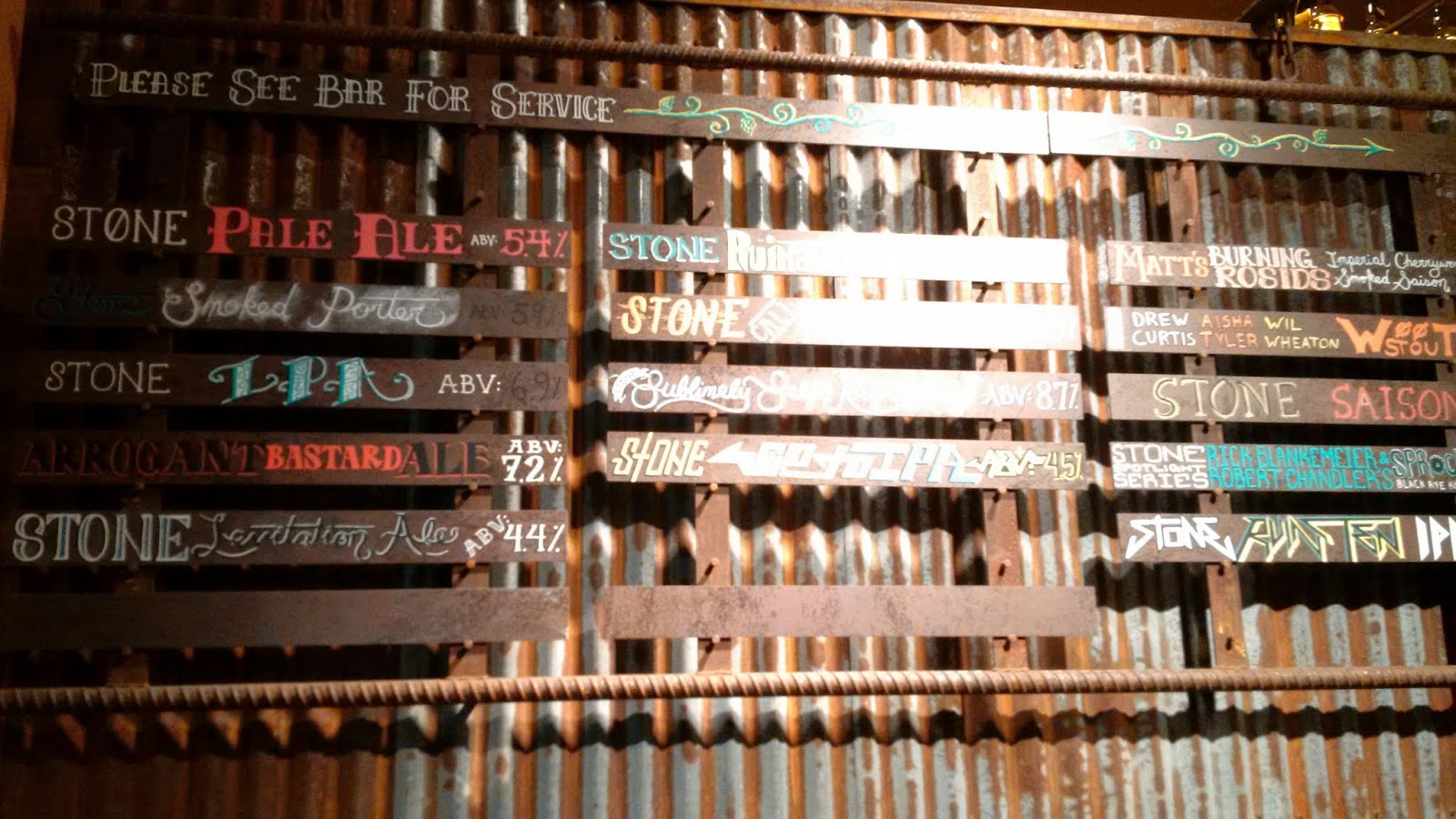
My annual trip to San Diego had a new target this year, the new Stone Brewing Tap Room on 795 J Street, within spitting distance of Petco Park, and just beyond spitting distance of our hotel. Given that trips out to Escondido have never been on the cards (apart from last year's ill-fated visit), it was great to learn of this new venue close to the heart of San Diego, supporting the Liberty Station venue just to the north of San Diego city proper.

The Tap Room is set off the street, in a recently restored, attractive 1927 Simon Levi Company building, shared with a restaurant on the other side of the foyer. As with all Stone bars and restaurants, there's a slightly industrial feel, which I like. It's classy and understated, seemingly in contrast with their almost Messianic marketing, and the same goes for their two other locations I've visited. With just a few tables, a bar and a wall with merchandise, it's an intimate kind of surrounding, and had a chilled atmosphere.


Our small group arrived shortly after 8pm, with a bit of a hunger and thirst from working at a conference in the SDCC. First a beer! There's quite a choice, many of which are available in bottle form in Europe, so straight into the fray.


At a mere 4.5% ABV, Stone's Go To IPA is almost an oddity compared to the rest of their range. Intended to be a "session IPA" that delivers the hop levels we all know and love from Stone, but at a strength you can have two of. Well, not that strength has ever stopped me having two if I liked it!
Big, clean grapefruit and lemon aroma, backed up with freshly mown grass and herbs. Lovely fruity backbone, with notes of old-fashioned pear drop candy and sorbet kicks. It finishes with an assertive grapefruit sorbet finish, somehow gentle by stone standards, but nicely rounding it off. Certainly a beer one could have more than two of!

Stone Go To IPA
The menu here is thankfully short, looking a tad healthier than what we'd been eating to date in San Diego. Although having said that, the spicy Thai curry chicken flatbread that I ordered , which to my mind was a pizza, was quite large and definitely filled me up, as well as giving me a good sweat. Went well with the Go To too.


While pondering on what to drink next, the right side of the board was a real draw, featuring seasonals and one-off brews that's I'd have been stupid not to try.


The Stone Spotlight Series (auto-corrected on my phone to Schöne Spotlight Series) is a nice idea, allowing the creative juices to flow amongst Stone staff. The first winner and release from this internal competition is Spröcketbier (that's definitely a metal umlaut there), a Black Rye Kölsch-style beer using carafa malt to get the colour and more hops than a true Kölsch has any right to.

At 5.4% and 40 IBUs, it's by no means a monster, and indeed, the auto-correct had it right. Sehr schön. Roasted malt and light coffee aroma, backed with a sweetness suggesting dried fruits, prunes, and a touch of grass. I'm beginning to think Stone should be doing more of these sub-6%, "low" IBU beers, as Spröcket was a revelation of easy drinkability. Creamy, with dark caramel, a light roasty/toasty bite, meshed with a grassiness and a touch of spice that lightens it. It leans towards a porter, really, so I would not have been able to tell if it had been lagered, but whatever it is, it's a fine tasty beer, and another one I'd happily have had several of.

Stone Spröcketbier
Having recently brewed my own Saison for the first time, I had to try Stone's take. The Stone Saison comes in at 6.3%. It's got a light, sweet vinousness nose, reminiscent of a sweet dessert wine, like a Gewürztraminer. With a sweetish lemon and lime overtone, on top of a biscuit and fruity base redolent of lychee, and just a nip of grapefruit. An earthy, yeasty trace runs through all of this, delivering a satisfying, hearty beer. Another like from me.

Stone Saison
The main problem with this place on a week day, is that it closes at 10pm, which put a bit of pressure on the drinking pleasure. So with limited time, and not neing sure if we'd get back again, what with our overly full confernece schedule, it had to be the W00tStout 2.0. Our own Ian Bergin had mentioned this in a tween the week before I left for San Diego, and having looked at the Stone website, it said it would be available soon. That soon was now!

W00tStout 2.0 comes in at 13%. Bound to be a heavy hitter. First thought:  Woah! It exudes masses of dark fruits, molasses and vanilla. "Oily as f***", I wrote. As it goes down, it's like melted dark chocolate, with oak and vanilla. Long roasted bitterness, but predominantly heavy caramel, cut with an alcohol warmth. Really quite wonderful.

W00tStout 2.0
A couple of days after returning to Germany, they finally announced their Berlin location. I'm not sure what to make of it (especially the crowd-sourcing), but the selfish side of me is hopeful for beers like this fresh on my doorstep (or as close as be damned).

Sunday, 27 April 2014

Dogfish Head 120 Minute IPA

4 comments
I don't exactly know how long I've had this bottle, but I'm pretty sure my mate Rüdiger brought it back from the US while I was still living in Münster, as I seem to recall it living in the cellar there for a while. That''d put it at over 4 years. At something like 18% ABV, I always left it to one side, thinking to have it for a special occasion. You know, the special occasion that never comes up, so the bottle gathers dust at the back of a cellar shelf.

At the prompting of TheBeerNut ("get it down ye", which I'd not heard in some time), I threw caution to the wind and popped it during my week of "holiday".


Despite it's age, hop aromas exuded as soon as the cap was popped. It poured a clear, deep garnet, with a thick tan foam, and exuded rich, fruity aromas, suggesting mango sorbet, candied pineapple and hot caramel sauce, dark touches of plum mousse and hints of ginger spice.

Every sip revealed something new. While it started off sweet and fruity, it gradually yielded spicy elements, a ginger warmth, a cinnamon sweetness, then red wine tannic notes with autumn apples starting to decay on the ground. Then the heat comes. More spice, peppery and alcohol warmth. There's a bitterness, like warmed up grapefruit juice, but tempered by a sticky sweetness. Or perhaps it was the other way around. The finish is long and sticky, as expected, like having Seville orange marmalade on buttered toast with a cup of milky tea beside a pine-log fire.

I'm really curious what this is like fresh, but I'm just as happy having tried this with a bit of age. Sumptuous and very enjoyable.

Wednesday, 26 March 2014

Not out of the woods yet

0 comments
As a short appendix to my BrauKunst Live 2014 posts, there were a couple of beers that didn't fit into that series, being foreign and somewhat random, but worthy of mention. Kiesbye's, from Austria, had a booth doing a steady trade, with a rather interesting blackboard of beers on offer. I'd already read about them regarding the annual Waldbier (Woods beer) they brewed using Tanne (fir) in 2011, Zirbe (Swiss pine) in 2012 and Lärche (larch) in 2013. I went with the latter.


Kiesbye’s Waldbier 2013 (Lärche) has a soft, spicy aroma, (a mild curry came to mind!) with an underlying fruitiness that I found hard to define (honey melon?), with highlights of green apple skin and a gentle citrus element. While I'd been expecting something very resinous, it was instead a soft, cosy, pillowy kind of experience, with soft pine-ish warmth (I can't say I know what larch tastes like). A mild bite at the finish wraps it up nicely. An interesting beer, so much so, that I'm now looking for larch trees in my area to brew one of my own!


Over at the BrewFist booth, they had a beer that was probably my favourite beer name of the festival: Czech Norris Pils. At 6.7%, a bit more than a Pils, but what kind of punch did it pack? With a surprisingly delicate nose, suggesting lemon meringue and spices, not the tough guy beer you might expect, following that with a lovely, creamy mouthfeel, nutty, toasted bread, and summer fruit flavours, it's rather nice and well made, I thought.

Friday, 21 March 2014

Braufactum Progusta Harvest Edition 2012

8 comments
When it comes to Braufactum, the craft beer branch of Radeberger Group, I am more than aware that I sometimes seem to have something against them. I don't like the "gourmet" pricing, yet I love the branding. I don't like that the backing of the company is not so transparent, but I guess I like that they can brew their beers in all sorts of places now owned by Radeberger (even if they don't always say where). But, credit where credit is due, they do some pretty mean beers. Case in point, the Braufactum Progusta Harvest Edition 2012, which I had last weekend, a beer brewed with green hops, within a couple of days of the harvest.


An inviting-looking, reddish amber with a rocky, off-white foam, probably helped along by the glugging induced by the long neck on that 750ml bottle. Although the aroma was not jumping out as much as I expected, perhaps due to the fact it had been in my cellar for about a year, is was deep and rich, with warm spices, earthy, tangerine all on a caramel digestive biscuit base. First impressions on tasting is the creamy mouthfeel. A really superb body. Front-loaded with dried apricots, creamy vanilla fudge and hints of marzipan that lead to  a lemon and mango sorbet finish, prickling on the tongue. There's a lasting bitterness, reminiscent of Seville orange marmalade and just a twist of pine resin to spice it up. A really lovely, luscious beer. I polished the bottle off easily, and would gladly have had another in the same sitting.

Friday, 14 March 2014

Reinheitsgebot AND Organic? Must be good!

5 comments
Last year, my wife and her mother paid a visit to Abtei Neuburg (also called Stift Neuburg, or Neuburg Abbey), just outside Heidelberg, and being the decent human beings that they are, brought back a selection of beers from Brauerei zum Klosterhof, within the Abbey complex

Brauerei zum Klosterhof brew organic beers, identifiable by the Bio badges on the neck labels. I've had both good and bad experiences with organic beers in the past, and firmly believe that organic, or the Reinheitsgebot for that matter, is no guarantee of a good, tasty beer, as even the best of ingredients can be used badly. But I'm always happy to try anything new!

Greenish-gold, with a slight haze and thick, frothy head, Klosterhof Heidelberg Pils has a somewhat yeasty/bready aroma, spliced with a cut of sulphur and lemon. Lightly grainy, with an underlying lemon and lime flavour, with green apples, that might start looking good on paper, however, it is predominantly sweet, with cabbagey undertones, rendering it soft and dull, if unoffensive.


Klosterhof Heidelberg Helles has a sourish, sweet almond aroma, and a flavour that suggests amaretto diluted with 7-Up and boiled cauliflower. Overly sweet and unpleasant, I have to admit that it went down the drain after half of it was consumed.

Klosterhof Heidelberg Weizen starts promising, with nice cloves and the classic banana aroma. Oddly, not much of that comes through in the flavour, which is thin, despite a pleasing creamy texture. Lightly metallic, with a cardboardy underbelly, another dull, unpleasant experience.


Klosterhof Heidelberg Bernsteinweizen was a little darker than the standard offering, and not quite as dark as a regular Dunkel Weizen. Quite nice fudge aromas show up, with a warming clove element, as one would expect. Also a tad thin, lie its sister, but with an interesting acidic edge that freshens things up. Caramel malts, sweet apple, soft cloves. The best of the lot.


And finally, the Klosterhof Heidelberg Dunkles. I have a soft spot for Dunkel beers, so hopes were high on this one. With light, fruity nose, suggesting summer berries, it gets off to a lovely start, but on swallowing, it suggests nothing more than thin Ribena that has been infused with old cornflakes boxes. Poor.


I feel it's only fair to state that at the time of writing these notes, all of these beers were just after their best before date. But would that render them so bad? My experience tells me not, unless their bottling plant is sub-par. I should also point out I've had multiple bottles of some of these (Dunkles, Helles, Pils), when fresh, and frankly, I had the similar thoughts then. I feel a bit bad about slating these so completely, and I see from their website that they are also seasonally brewing IPAs and other ales. Cashing in on the latest trends? Perhaps, but I've no problem with that, and would love to try them.

In short, the lesson to be learned is that organic ingredients do not translate to better beer, any more than a Reinheitsgebot or craft label does. It's the ingredients combined with the brewer's skills with the art and science of brewing that makes good beer. But I guess most readers here already know that.

Thursday, 6 March 2014

Braukunst Live! 2014 - The Nøgne Ø Session

0 comments
As with the previous two years, BrauKunst Live featured a full programme of masterclasses and talks. I hadn't planned to attend any of the paid ones, but was talked into the Nøgne Ø session by Gerrit, and yeah, it was worth the extra fiver. Not just for the drinks, but to hear Kjetil Jikiun speak for a while about the principles on which Nøgne Ø was built.

Now, I have to admit, this was nearing the end of the evening, and there were seven drinks served in rapid succession, with Kjetil talking the whole time, so my notes are patchy, as it was hard enough multitasking to drink and listen attentively!

For a beer tasting, I was surprised we were to start with a Sake, I think the  Nøgne Ø Sake Yamahai Motoshibori. Apparently they got it into their heads to just try making it, then couldn't sell it locally, as it was so unlike the usual bland Sake that people were getting in restaurants. Craft Sake? I guess so! I'm not an expert, but I liked it. Tart, with tinned pears, almonds, gooseberries. Quite unlike any Sake I've had, though in fairness, that's not saying much.

The Sake
Nøgne Ø Pale Ale brought us gently into the beer round. With Northern Brewer for bittering and Centennial for the rest, it was a good opener. Nutty, creamy, orange pith and grapefuit bitterness. Fairly straightforward.

Nøgne Ø Two Captains Double IPA originally stemmed from a homebrewing competition winner, in fact, a former Scandinavian Airlines friend of Kjetil, so when it was brewed at Nøgne Ø, it was called Two Captains. Did I mention, Kjetil was an airline pilot and homebrewer, who used to bring back 25kg sacks of malt in his suitcase, because he couldn't get the supplies he wanted in Norway? Apparently, and I'm not sure this should be put in writing, but Two Captains was originally homebrewed as a Pliny the Elder clone. Piney, with masses of orange pith on a creamy caramel base, it's chewy and bitter, and rather delicious.


For the next one, I wrote down India Saison, which must mean it was the Nøgne Ø / Bridge Road India Saison, as I also noted it was brewed with Australian hops and Belgian yeast. And very nice it is too. Snappy, fruity, with hints of tropical fruits and citric leanings, just a little funkiness and a mild, nutmeg-like spiciness to keep it interesting. I like Saison, and I like IPAs, and this blends the two rather well together.

Moving into more experimental territory, was Nøgne Ø Tindved, They don't do things in half measures at Nøgne Ø. This experiment was an 18.000 litre one, where they added lots of juice from pressed sea-buckthorn berries, thinking it woulfd ferment out and give them a sour edge. As it turns out, it did not ferment out, so they had somehting a lot sweeter than planned. So what did they do? They added Brett, as that'll eat anything. Sure enough, it dried it up, resulting in quite a tart beer, with red currants, just-about-ripe strawberries, and a definite horsey layer, nicely showing off the Brett action.

The beer I noted as being" the one with the Eskimo with shades on the label", turned out to be Nøgne Ø Sunturnbrew. At least I knew it was a smoked barley wine! Butterscotch, sweet, light phenols, suggesting pipe tobacco, lovely oily texture melding that with a thick caramel base, and a reasonable bitterness. 

The final beer was the Nøgne Ø Imperial Stout, which Kjetil said was probably their most famous beer. My notes just say "Mmmm...". Enough said.

Looks like somebody asked a stupid question.
It's nice to get a concentrated look at beers from a brewery, and even better when they are hand selected by the brewer. One of their core values is that they want that when a person finishes a bottle of their beer, that they'd like another. I think they're succeeding on that count.