Saturday, 1 March 2014

Braukunst Live! 2014 - Kunst oder Künstlich? Should we really care?

4 comments
The craft versus crafty debate (or in my poor German, above, art or artificial), and the ensuing attempts to define craft, also washed over Germany recently. Or at least for a period. Don't worry, I'm not going to enter that debate now, but what did interest me is how some of the biggest, and indeed some of the more modest sized, private regional brewers, are adapting to the apparent change in tastes amongst a small part of the German beer drinking population. At a time when the number of breweries seems to be increasing, while beer sales are falling, I've noticed in the past few years an increase in the so-called Gourmet beer segment, which to my jaded eye seems like a desperate attempt to get more cash for less product, trying to catch those with more money than sense. Thankfully, most of the smaller brewers producing interesting beers are doing so at reasonable prices, even compared to the wonderfully low prices of perfectly decent table beer in German, which still has me cackling to myself with glee, when I consider beer prices in my native Ireland.

Braufactum at BKL2014.
Braukunst Live! 2014 gave me an opportunity to sample from the craft-styled offerings of one of Germany's biggest brewing concerns, as well as some surprise brews from a relatively local, medium-sized brewer.

Bitburger (3.86 million hectolitres in 2008) is one of those breweries I have mixed opinions on. Well, kind of. If it wasn't for them, Köstritzer might have disappeared, but I'm not a big fan of Bit as a beer, and can't say I approve of the price fixing news from a couple of months ago. Last year, they launched a new range of beers under the Craftwerk brand, which is based out of their pilot brewery. Given the name, it is almost certainly cashing in on the craft beer trends in Germany, but from what I understand, the brewer here has pretty much complete control over what is brewed, but who can say what the Bitburger marketing machine does after that? But the thing that I have respect for here, is that they are not touting Craftwerk as something completely separate, as it's very clear on all the printed material and labels that it is a part of Bitburger. Compare that, for example, to Braufactum, owned by the Radeberger Group, which in turn is owned by the behemoth Dr. Oetker. There is zero mention if its provenance anywhere obvious. The only giveaway on their website is if you look up the business address, which is shared by Radeberger. That's not to say that Braufactum don't do very tasty, interesting beers, but the lack of transparency is something that, as a beer consumer, I don't like so much. Well, that and the "gourmet" pricing, though one has to say, the marketing and presentation is really beautiful, and why wouldn't it be?

But back to Craftwerk, and their three offerings. Craftwerk Tangarine Dream is a single hop IPA using Mandarina Bavaria, and bears all the hallmarks of that on the nose (does what it says on the tin). Slightly buttery, with light orange (so tempted to say tangarine) and salty caramel, it's got quite a tart hop bite, verging on aggressive, not helped by a thin, biscuity base. It's fine and fruity, but could benefit from a bit more body to round it out.


Pretty clear where this came from.
Craftwerk Hop Head IPA⁷  has quite a list of hops going into the brew. Herkules, Magnum, Taurus, Cascade, Centennial, Chinook and Simcoe. Quite a few of my favourites in there, so looking good on paper. Served on tap, Hop Head is a hazy gold with a pleasing aroma, rich with melon, honey, lime and fresh-cut grass. Fruity and fudgey, with a creamy mouthfeel, it strikes a nice balance , while a warming, spicy hop hit brings up the rear. Long-lingering peppery heat and a pithy bitterness left me thinking they might be on to something good here.

And the last of the three, Craftwerk Holy Cowl, listed as a Belgian-style tripel (but brewed after the Reinheitsgebot, so none of those evil sugars here). The nose is spicy with cloves, fruity with hints of banana and dried apricots, and a tad yeasty. Most of this comes across in the flavour too, with an added dose of earthy hops. It's very spicy, with a gum-tingling carbonic bite, or perhaps it was an edge of sourness, but it's certainly well-carbonated. I got the impression of it being more like a Weizen Doppelbock, with added zest and spice, not that that's a bad thing!


Overall, not bad efforts, and certainly packing a lot more flavour in than a Bitburger Premium Pils, and at prices like €2.35 for a bottle of the Hop Head IPA, well, more than double the price of a regular beer here, but definitely not breaking the bank.

Having completed that bit of research, it was around to visit Distelhäuser (ca. 190.000 Hectoliters per annum). I'm on the record of having said I was never a fan of Distelhäuser Pils, but quite like their Export, and have always thought of them being fairly traditional. That was until I came across their Blonde and Special in my local, tiny drink store, and came away with two six-packs filled with surprises. I'd also seen they had some porters and IPAs at the Grünen Woche up in Berlin, so my curiosity was killing me, what with them only being a 50km drive from where I live.

Distelhäuser Lucky Hop was served from the tap, a 7.7%, 77 IBU concoction with 5 hop varieties. Dark amber, unfiltered, with a pretty stable foam crowning it. Soft caramel, mandarin, strawberries. Big, hop-forward bitterness, but tempered by a fruity sweetness and soft, creamy carbonation. Quite a good effort!
Distelhäuser Lucky Hop IPA
Distelhäuser  Loch Ness Stout weighed in at 4.7%. Completely opaque, black as night. On the nose, it's chocolaty, yeasty, toasted rye bread and a suggestion of wood, while on the tongue, it's creamy, fruity with blackberries, a touch of vanilla and wood, with a dark chocolate bitterness rounding it off. I have to admit, it was a lot more than I expected. My views of Distelhäuser were continuing to sway.
Distelhäuser Loch Ness Stout. I think.
And finally, Distelhäuser Black Pearl Porter,  a slightly heavier 5.6% with 28 IBUs. This was a surprising fruit bomb. Big berries, and fruity as hell, with vanilla, and a deft touch of sourness cutting a soft toffee maltiness. I've had some god-awful German porters in the past (Lausitzer, anyone?), and a few really excellent examples, and while this might not check all the BJCP style guide boxes (did I really just type that?), I really enjoyed the surprise of it all, and would happily drink a pint.

I don't know if these Distelhäuser beers are going to be hitting the stores around my area, or if they are just experiments shown at festivals, but I do rather like that they haven't tried to market these under any other label than Distelhäuser or the diminutive Distel. No mention of the C word anywhere, they're just trying stuff out, which I can certainly respect, as in a medium size brewery, that could be seen as a bit risky in some circles (till now, they've brewed local beers for local people, nothing for you here!). I had a nice chat with the manager/brewer, and hope to visit sometime later this year for a closer look, but I certainly hope that I see beers like this in my local drink store.

So, that's a small look at a huge and a medium-sized brewer, doing stuff in my playground. Is it crafty, in the sense the Brewers Association described? On reflection, I'd have to say no, or at least not in these cases. Despite calls for some sort of global definition of what craft is, I think the benchmark varies so widely from country to country, that it's simply not possible, or at least not in any meaningful way. Even the BA seems to be in the habit of changing their own definition to suit their members. In Beoir, we set Irish Craft Beer as something very easily defined, based on volume, place of production and ownership. No mention of passion as an ingredient whatsoever, but then drive is a given with the Irish craft brewers. While Craftwerk might be playing the craft card, at least it completely transparent where the beer is coming from, and as a beer consumer, that's something that I can use to make the right choices for myself.

Next up... hmmm, maybe the Nøgne Ø tasting.

Friday, 28 February 2014

Braukunst Live! 2014 - The Traditionalists

6 comments
Can you teach an old dog new tricks? How do the long-standing, traditionalist breweries react to new trends in the German market? I sampled a couple at BrauKunst Live! 2014.

Schlossbrauerei Au has been around since 1590, so I think it's safe to say that it has a long tradition, and still with a Baron Freiherr at the helm. So it was interesting to see their beer list with a few oddities. First up, the Schlossbrauerei Au Grätzer. At 4.4% (12,2° Stammwürze), Gerrit and I were not sure if it was "to style", but frankly, neither of us really gave a crap. What it is, however, is an unfiltered dark straw, with a big, pillowy, banana aroma and a light clove touch. Same on the flavour, but cut with a delicate sourness, like a squeeze of lemon, finishing dry and long. The ingredients listed Weizenmalz, Rauchmalz and Spitzmalz, but there can't have been much in the Rauchmalz department, as that was quite subtle. Have to say, though, I quite liked it!

What I had visited the booth for, however, was to try the Schlossbrauerei Au Eiskeller Rotweinfaß, aged, as the name suggests, in red wine casks. Pretty much a Doppelbock that was either going wrong or out of date (I'm not great with that dialect), they decided to experiment and put it into Italian oak wine casks for 12 months of aging. The result is quite remarkable. Big aroma, redolent of red berries, oak and vanilla, likewise, the flavour is bold, with raisins, raspberries, cherries, vanilla, with a gentle woody touch in the background. A sweet, marzipan-like finish wraps it up nicely. With only 1600 bottles made, I'd be quite hoping they try it again!


And on to Fürst Wallerstein. No simlpe Barons here, but a proper Prince! Presented at the BierTraum booth, I asked to try the 1598 Fürst Wallerstein Edition Privée. I was told that this beer was expensive and that, normally, they'd ask for 10 tokens for a 100ml  sample (that's €5, I think), but they made a deal with the brewery to let it go at just 5. It normally retails at €90 a bottle. I wish he hadn't told me all that before trying it, as that set expectations high. Though I'm glad I didn't read the description on the 1598 website either, or I would surely have felt unworthy to request a sample. Be that as it may, I got my sample and retreated to a safe distance, clutching business cards of the reseller and the Fürst Wallerstein sales manager, which I felt obliged to accept.

Clear amber, with not a trace of carbonation, it has a pleasant cherry, caramel and bitter almond aroma. Flavour-wise, well, rather dull, given the price tag. Slightly syrupy, with sweet caramel, soft fruits and a taint of cardboard hovering at the edges. Shame, really.


And so to an old hand at the game, both in traditional and not-so-traditional brews, our friends at Schneider Weisse. I have to admit, I love Schneider beers, and spent several happy hours in the Weisses Brauhaus last year, not to mention them being regularly on my cellar shelves. And looking below, you'll see they are well loved by the crowds at BKL.


There was only one beer that needed sampling, and that was the new Schneider Tap X, Meine Porter Weisse. With an aroma that hinted rather heavily at the Weissbier components, there wasn't much portery going on, apart from a hint of milk chocolate. Neither was much in the way of dark malt roastiness to the flavour, but there was certainly lots of tasty dark berry things going on, mixing well with the juicy, Weizenbock-like flavours. I have to wonder why bother calling it a porter weisse, when it nods vigerously in the direction of a Weizen Doppelbock (and oh, how they do that so well). I'll be sticking to the Aventinus, which is also more suited to my price range.

Next up, craft or crafty in Deutschland? Or do we really care?

Wednesday, 26 February 2014

Braukunst Live! 2014 - The Brewpubs

4 comments
I had fully intended to sample broadly from the smaller German breweries at Braukunst Live! that I'd not heard of before, but somehow got waylaid. But at least I tried!

OMG!
Maxbrauerei Biermanufaktur is a small inn and brewery, opened in 2010 in a renovated stables in Altenstadt, Oberbayern. What I found interesting about these guys, is that as well as their regular range of two, they have a monthly beer, that they have planned a year in advance. The 2014 calendar features beers like a Russian Imperial Stout (December), a Saphir Weizen (November), a Rogger Ale (June), and so on.

At Braukunst Live, they had the January and February offerings. January's was Maxbrauerei Böhmisch Dunkel, brewed with Saaz hops. Reminiscent of rye bread and toast, with a pinch of graininess and a green apple edge. Nothing to shout about, but fairly drinkable.

Their most recent offering was the Maxbrauerei Indian Pale Ale (their Indian), a yeasty, amber affair, with fruity overtones, the expected citric bite, but suffering from a butteriness that left it flat. Shame, but then there's something else coming next month!

Just an observation on the name of the brewery including the "Manufaktur" element. This seemed to be a bit of a trend, as there were at least a handful of breweries now sporting this moniker, leaving me wondering if they were trying to take a leaf out of the Braufactum handbook, using Manufaktur as an indicator of something crafted by hand. Let's see.

And speaking of playing the craft card, the next beers were from Kraft Bräu, from Trier, way over by the Luxembourg border. These guys, based in the Hotel Restaurant Blesius Garten, have been around since 1998, but I can't say if they had the name Kraft Bräu, or the sub-title 1. Trierer Hausbrauerei first. No matter, it's the beers that count.
Can't avoid the Lederhosen around here.
Starting with Kraft Bräu Seb's Pale Ale, served by Seb himself, I tried to ignore the questionable label and concentrate on the contents. I was told they wanted to aim for drinkability, and model this more towards an English style, rather than the fashionable American Pale Ales, despite being brewed with Willamette and Cascade. And you know, I think they succeeded. Balance is the name of the game, with sweet, fudgy malts, floral, herbal hops, and a light, orange-tinted bitterness. Unoffensive (at least the beer was) and decently sinkable, so I can't complain too much.


I said I'd like to try another of their "normal" beers, and was offered the Kraft Bräu Helles Saphir, which, as the name suggests, was dry-hopped with Saphir. I can't say I'd call it normal, in the sense of a German Helles, what with the big floral, resiny nose, and a lovely honey/melon flavour in the midground, and a  light carbonic bite cutting through to passion fruit and a soft, chalky dryness. Really refreshing and one I could happily drink all day.

Moving up the scale to the Kraft Bräu Edition IPA, at 7.5% ABV. Creamy, soft citrus notes, solid caramel base and a full body, I think this was another winner, and a far classier label.


On a separate board, they had a barrel-ages Kraft Bräu Treverer Porter. Lots of berries with lashings of vanilla, a deft touch of sourness, mild chocolate and roasted edge, and a lingering raspberry and chocolate finish. I was starting to like these guys, but thought I should be moving on.

Well, just one more. The Kraft Bräu Bourbon Chocolate Stout. With a port-like, vinous notes, vanilla chocolate, mild coffee and toffee, and deceptively light and creamy for a 9% imperial stout. Very good.

I'd like to find out more about Kraft Bräu, and what is behind the brewery, and how a hotel brewery (albeit quite a fancy-looking hotel and spa) can take the risks to make such a range of beers, and I wish Max & Co. luck with their ongoing project, as I like their ideas and guts starting something like that.

Next up, a look at a few breweries I would call "traditionalist", or certainly with what seems like a long pedigree, and a fair few "vons" in their history!

Monday, 24 February 2014

Braukunst Live! 2014 - The New School

2 comments
A year in the German beer calendar seems to have gone by very quickly, with Braukunst Live! creeping up almost unexpectedly. After a fairly slow festival last year, from a personal perspective, this year I decided that two days was needed to do it any sort of justice. The final published, and most certainly incomplete, beer list for this year listed 431 beers from nine countries, 252 from Germany alone, so there was a lot to bite off.

While the general format remained unchanged, being somewhat of a mix between beer festival and the feel of a trade show, it felt to me like there was a certain maturity to how everything was presented. At least the presentation at the booths was of a generally higher standard compared to even last year, feeling somewhat more polished and professional, while retaining the character of each brewery presenting. However, there was a lot to cram into the MVG Museum, and Saturday got particularly crowded both out on the floor, and definitely at the woefully inadequate toilet facilities, despite the addition of portaloos outside the venue. If they continue to expand and attract the growing attention, I'm really hoping they choose a bigger venue (also with more seating and better catering facilities) for next year.

But, on to the more important aspects, the beer! I had an unwritten agreement with myself to try and focus on the German breweries, and beers I had not tried before, but of course failed on both counts, not that I'm complaining. So first, beers I tried from what I might loosely describe as the new school of brewers, ranging from some relatively new, to those with a longer brewing heritage, that took the leap to Craft several years ago.

The gang of six
First stop, straight to see Thomas at Hopfenstopfer, to see what new creations he'd brought. Taking a departure from the excellent pale ales I'm used to seeing from Hopfenstopfer, he had a red ale, Hopfenstopfer Dark Red Temptation, on offer. An unfiltered amber, Dark Red Temptation has a banana-y, fruity nose, with bready, doughy malts in the back. The 9% alcohol comes through with a warming sensation, complemented by a soft, chewy body. Lots of toffee, a slight graininess, and a strawberry, minty-hop finish. Quite heavy after a while, but it does finish relatively dry, though a little floppy.

Hopfenstopfer were at a joint bar with a collective of independent small brewers, including Braukunstkeller, Paxbräu, Kehwieder, Schoppebräe and Ale Mania, formerly known as FritzAle. So, it was a quick step to the left to sample from Hamburg's Kehrwieder, of who I'd heard good things. Their new single hop IPA Kehrwieder Hüll Melon showcased the hop of the same name. Remarkably fruity on the nose, it shouts strawberry jam. Loudly. Less so on the flavour, but it's a tour-de-force of exotic fruit flavours, coupled with light honey notes, grassiness, and a bunch of other stuff to keep you chewing over. Lovely stuff, that is dangerously deceptive, given the 7.5% ABV tag.

Kehrwieder Prototyp is not quite a prototype, being their first commercial beer produced over a year ago, which kept its moniker. A dry-hopped lager, using Northern Brewer in the mash, Perle in the kettle and Simcoe and Saaz for the dry hopping, Prototyp is juicy-fruit all the way, with a deft touch of fudge for good measure, and a drying smack of grapefruit to the finish. Very pleasant and refreshing, and a safe 5.3%

I'm not such a fan of the name of Kehwieder Feuchter Traum (wet dream), but it's named so on account of it using undried, fresh "wet hops", namely German cascade. A clear, pale amber with a fudgy, mandarin aroma, it has a wonderfully light fruity flavour, bitter orange and toffee, with a sudden, dry finish, almost chalky and lingering orange pith.

I'd been informed that all six of the breweries listed above had made a collaboration brew for the event, something they did via a FaceBook group they set up after last year's Braukunst Live. Triple Nipple (or maybe Tripel Nippel?) might have been a case of too many cooks spoil the broth. I found the aroma muted, with just a touch of grapefruit pith, but then it was served too cold. A little more came out when heated in the hand. But still, a bit of a one-trick pony, being all about the orange and grapefruit, and not much else for me.

Later in the night, I returned to Hopfenstopfer to hit the rest button with a Hopfenstopfer Comet IPA, which I noted on last year. Still a great beer, and the best rated beer (and best rated brewer!) out of Baden-Württemberg on ratebeer!

There's one thing I'll say about this little group. While they don't appear to have the marketing budget of some of the other newer German craft breweries, who seem to spend a lot of time advertising their dedication to the craft beer cause, living the craft beer life and looking more like it's a lifestyle than a drink, these guys just quietly go and brew great beers, and I've a lot of respect for that. Actually, respect, and lack of in some cases, was a recurring thought through my two days at Braukunst Live.

But moving along to another old hand, up the other end of the hall, whose beers I've certainly enjoyed in the past, Sebastian Sauer, and Freigeist Bierkultur. I have to admit, the randomness of the selection available gave me pause, but the Freigeist Dark Jester (or was it The Monarchy Dark Jester? I'm not sure now), with juniper berries and bay leaves sounded intriguing. Sour and a little band-aidy, the latter left me a tad undecided, and while I enjoyed the herbal elements, and the sour bite, it hit so many buttons. A brewer, who shall remain unnamed, gave me his opinion that most of these beers were random creations with crazy stuff just to sell in the US. He might say that, but I couldn't possibly comment. However, I can say I've immensely enjoyed pretty much everything I've tried from Freigeist up till this point.


And so, close by, to Maisel and Friends. I've put them in this post, because I saw them last year, and I think I even tried the Bock. While they might not rate as particularly "new school", given that they have the same selection of three core beers as last time, they are at least on trend, and their beers in 750ml bottles are fairly priced, which is more than I can say for some out there. Jeff's Bavarian Ale was the choice, a 7.1% wheat beer with a strong fruity aroma, dishing out blackberries galore. Quite decent on the swallow too, with a mildly solventy alcohol hit, but creams, with more dark berries and mild clove spiciness.

That'll do for this post. Coming next, some brewpubs doing something different. In the meantime, some shots of post-Braukunst Live beers at Camba Bavaria's Tap House. No note-taking here!


And the post-post-BrauKunst Live beers in the hotel lobby!


BKL2014 Part 2: The Brewpubs
BKL2014 Part 3: The Traditionalists

Monday, 30 December 2013

The last days of Advent

0 comments
I soldiered through the last of the advent beer calendar last week, so here's a final push of the last lot. Sorry, this is going to be quite a lot in one go! :)

Door 15 hid a Schönramer Bayrisch Pale Ale, one that i was eager to try, given the Schönramer beers I'd tried at BaruKunst Live 2013. A pleasingly sweet aroma, cut with pineapple cubes candy and a touch of grapefruit pith. Quite light on the body, verging on thin, with a grapefruit-like bitterness hitting right on the first sip. It's full of zesty fruit flavours. Pineapple, light raspberry, apples, all on a clean rye bread base. The finish is dry, reminiscent of tonic water, with a long orange pithiness remaining. Light (even at 5.5%) and refreshing, but would love to try it with a tad more body.


Day 16 was a pack of beer-related cards. Well, cartoony, and would have been nice apart from the crap sexual innuendo jokes on some of them, otherwie my son would have got them.

17 Was Zötler Gold. Looking like standard fare, aroma-wise it delivered pretty much simple pale malt aroma, with a touch of sulpher and a mildly vegetal underbelly.  Nutty, salty, a little cabbagey, grainy and watery. Enough said so.


18 was a nice surprise. I've had a metal Schlappeseppel sign, given to me by my Father-in-law, for years, but had never tried their beers, so seeing a Schlappeseppel Kellerbier, was quite welcome.  Pale and hazy with a good strong head, this had a decently crisp noble hop aroma, all pine, grass and softly herbal. Surprisingly creamy-textured, with a lemony bite, not far from lemon meringue pie, and biscuity to boot. A tasty drop!


Maxlrainer Zwickl Max was the delight for day 19, a helles with a light haze and short-lived head. Aroma-wise, is suggested nothing more than apple juice, which may not be a bad thing. Sweet and fruity, with a candy-like edge, tempered by a zesty cut. Slightly sharp on the finish, verging on acidic, but with a lingering grassy and digestive biscuit flavour. Overall, a nice combination, and another hit as far as I was concerned.


Day 20 was Hofbräuhaus Traunstein Weißbier, a hazy orange affair, with  a fine-pored, creamy head. This has a lovely, highly spiced aroma, with classic Weißbier cloves abundant, ripe pears and banana. A little thin and tinny, yet has a pleasing creamy/cream soda flavour, mild banana and a surprising pithiness that sharpens the finish. Overall, a fine summer refreshed, I'd say.


21 was a Tegernseer Hell. I don't know what it is about this beer, but I just fond it boring, so I didn't even bother making notes.


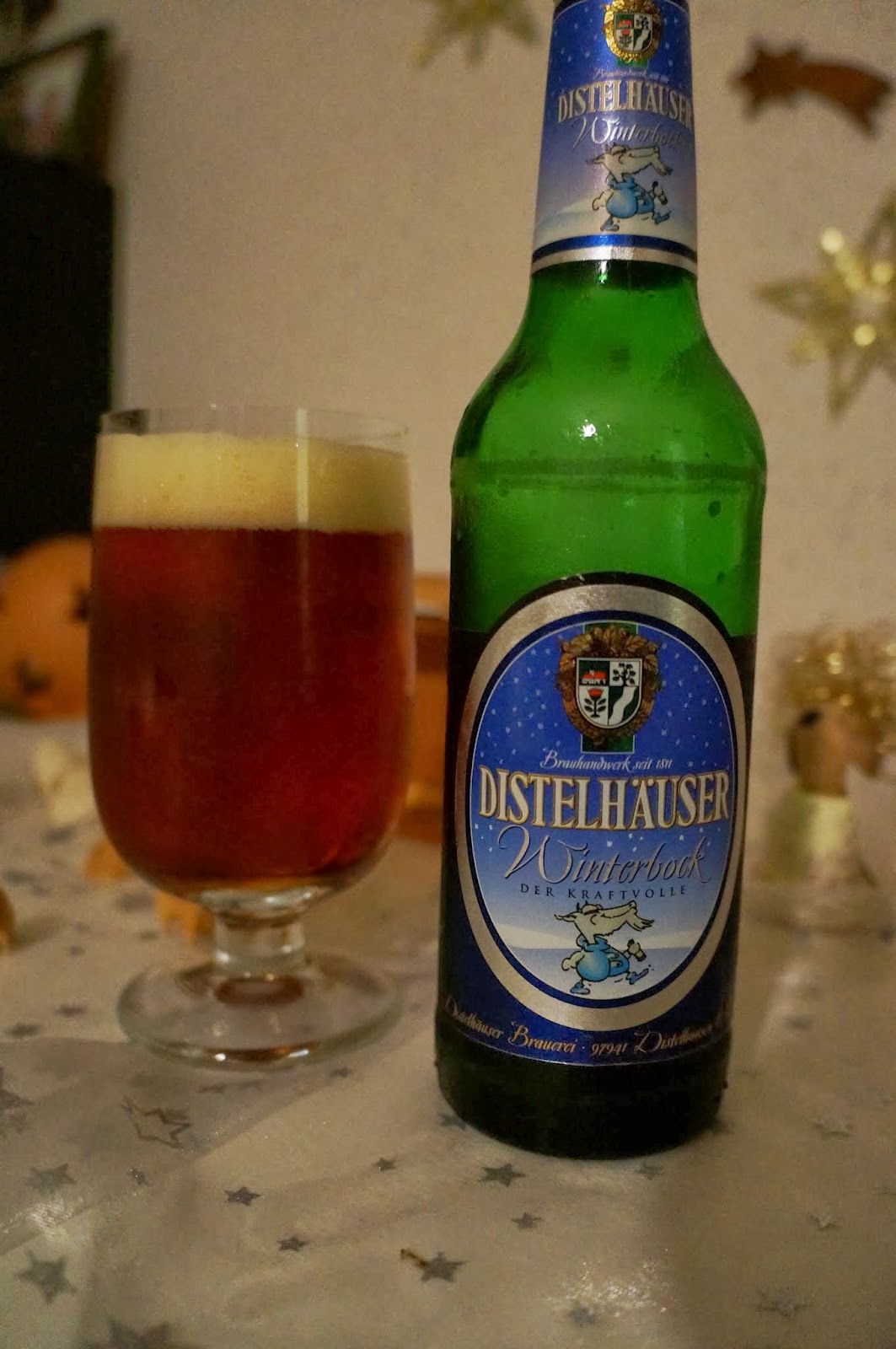
Day 2 was the biggest surprise, mostly because I didn't expect to find a Distelhäuser Winterbock in a Bavarian beer calendar. Distelhäuser is not far from where I live, and although a mere 10 kilometres from the Bavarian border, is most definitely from Baden-Württemberg. Having said that, my "local" regional brewer is one that I have a mixed relationship with, but some of their newer offerings have certainly sparked my interest. Their Winterbock has a muted aroma, gently candy-like and nutty, with soft caramel. On the tongue, it's grainy, with burnt caramel, a touch of dried fruits and bitter almond. Despite a creamy texture supporting all of this, it nevertheless feels somewhat threadbare.


The penultimate beer was a Karmeliten Brocardus 1844. It's rather fancy-looking, what with that red foil on the neck, and certainly fit the festive season. As did the lovely rich amber of the beer itself. Not much aroma to speak of, however it did give caramel, strawberries, blackberries and a touch of old straw on the flavour. The finish is sweetish, yet dry, with hints of honey and a very mild herbal bitterness. Ultimately, it looked better than it tasted.


And so to the final door, with much anticipation. Did they leave the best till last?

I like proper Märzen, so the sounds of Brauerei Irlbach's Goaßkopf Halbe Original Ur-Märzen, which the label says was almost a forgotten style, really was right up my ally. A sliughtly hazy old gold with a persistant head, this Märzen had a sweetish, floral aroma with dried grass. Certainly malt-driven, it has a clean caramel backbone with some fruity highlights suggesting sweet apples, but predominantly a dusty old hay and grass flavour. With a fullish mouthfeel, it's not so bad, so wile a little dull, it's almost comforting.


And there we are! At times, i was thinking i was glad i didn't buy this beer calendar, having won it and all, but there were quite a few decent beers in the box, and the vast majority were completely new to me, so it was absolutely ideal in that regard. They do have some other variants, and I think I'd quite like to try the general German one, as there's sure to be some nice surprises in there.

Thanks again to Felix for running the competition!


Friday, 20 December 2013

Advent bier catch-up

0 comments
Having been away for most of last week, a glut of advent beers from the Kalea calendar had built up, so it was only proper to make a dent in the supplies.

Number 8 was a Schwarzbräu Schneeböckchen Doppelbock. Sadly, I just deleted the photo of the bottle, and can't claw it back, but you can get an idea of it here. A deep, clear amber, Schneeböckchen is redolent of raisins, burnt sugar, autumnal apples lying on the ground, grass and mild spices. On the tongue, it's more raisins, a touch of oaky vanilla, an ever-so-slight hint of coffee roast, and at the back, a cinnamon-like spice. It's fruity-sweet, with a background of brown sugar, but not cloying. In fact, the body is rich, yet clean, and almost sharp at the finish, all the while leaving the lips slightly sticky. On the finish, it suggests caramel with a touch of nuttiness, a mild pepperiness and green grass. Certainly one of the better Doppelbocks I've had!

Door 9 yielded a beer glass, sadly chipped, with door 10 revealing the beer to go with it, Unser Bürgerbräu Alpen Stoff. Pale gold with a short-lived, tight foam, Alpen Stoff delivers a sweet malty aroma with highlights of marzipan and apple. It's rather fruity, almost like juicyfruit gum, with green apple and strawberry. A most odd beer, with unexpected flavours, but I think I liked it.


Beer 11 made me cringe on opening the door, mostly because of the clear glass bottle, which I dislike, but also because the label said to "serve icecold for max:taste". Leibinger Max Fünf Comma 2. My immediate reaction is that anything that needs to be served ice cold for maximum taste probably doesn't taste of much at all. Anyway, it had to be taken. The aroma is surprising, being fruity, with dried mango, passion fruit and light bubblegum, but it fails badly on the flavour-test. Cardboard, cornflakes, a hint of summer berries, but just a flash, mind, and not enough to rescue it. Dry, soapy finish, with lingering mandarin peel and baking soda. Unpleasant.


Door 12 was a bit more traditional-looking, with a Bayreuther Hell. A buttery-gold with a magnificent foamy head that didn't want to leave. A fresh, yet bready aroma, with sparks of green apple peel and citrus. Similar elements in the flavour. While sinking back mouthfuls, it's refreshing, doughy, malty, and then there's a kick of that green apple, freshly mown grass and a pinch of herbs. Quite gassy, with a little carbonic bite. Perhaps not an astounding beer, but a perfectly enjoyable drop, which is all that I could ask for.


13. Unlucky for some, and if you judge a book by the cover, unlucky for me. Another clear glass bottle, with an upside-down label to boot, but Brauhaus Schweinfurt's Alpha would get the benefit of the doubt. AGain, a beer with an aroma that surprised me, with hints of chocolate orange on a mildly herbal background. But the flavour... Lemony, sugary, soapy, cardboard. It's not often I can say this, but I didn't finish it, managing about three quarters before I dumped it.


However, rescue was on the way in the form of the classic Ayinger Celebrator, minus the little plastic goat you often get hanging from these bottles.The notes got sparse with this one, not because there isn't much to say about it, but rather because it's a nice distraction from note-taking. Chestnut coloured, with ruby highlights, and a densly packed, tan head, it has an almost porty aroma, with dark toffee and dried fruits. Christmas pud! Oily-textured, with cream soda, prunes, a lick of licorice and bitter chocolate, it's a fine beer for a cold winter evening, so I let it do what it does best, and seduce me. Prost!


Sunday, 8 December 2013

San Diego 2013: The redemption - Green Flash

0 comments
Following the disappointment of Stone Brewing, we needed something to redeem the plan we'd made, so we set the GPS to guide us to Green Flash. Now this place was hopping. We could already see there were a lot of people here, siting outside in the fenced off area, with a food truck keeping them fuelled, and a pair of large bouncers by the entrance. IDs shown, we made our way to the humming tap area of the brewery, with the full brew kit stretching out behind. There was a lot of choice, and limited time, so the taster glasses were the order of the day. Well, for me. Poor Rüdiger was the driver, so was being sensible, but I felt the need to dive right in.


Starting with pale and hoppy, I want straight for the Citra Session IPA and the Village Pilsner. The Citra Session (4.3% ABV, left in the photo below) has a green, catty pine aroma, which carries through to the flavour. It has a refreshing sorbet-like thing going on, but with a slightly chalky mouthfeel. A strong lemon zest and pithy orange finish wraps it up nicely.

The Village Pilsner (5.3%) is surprisingly Pilsner-like, something I didn't expect, given our location. If I had to guess, I'd say classic noble hops, and it stood up to any decent German Pils I've had, with a clean floral and resinous aroma, soft bready malts and a pine resin bitterness. The finish lets it down a tad, being a bit flabby, with a bubblegum note taking off the edge, and a drop of butterscotch in there too. Still, decent enough.


Staying in the pale zone, the Green Flash Belgian Blonde (6%). Effervescent sorbet, combining with mildly fruity elements (mango, strawberry, grapefruit, of course) and fresh, green hop flavours. Rather good!

Time to step up the alcohol and the shade, with the Green Flash Double Stout (8.8%), a big beer, redolant with coffee, molasses, dark chocolate. Soft and silky, it also kicks in with a gentle vinous flavour, backed with chocolate syrup. It somehow reminded my of After 8 mints, with a fresh hop hit on the finish. Decent.

I've not had enough rye-based beers, other than a couple I've made myself, so was eager to try the Imperial Red Rye (8.5%). Another fruity number, suggesting dark berries, and mildly spicy, with pepper, and hay. It finishes with a gum-tingling bitterness. Big and fluffy, a nice closer on an all too short visit.


We eventually had to leave. It wasn't so much fun, I guess, for Rüdiger, watching me enjoying myself, and our boss was sending text messages from San Diego, wondering when we were going to arrive, so we had to make tracks. A thoroughly enjoyable visit, complete with t-shirt purchase, and some really nice beers.

Later that evening, we went to Karl Strauss in San Diego. I can't say there was much to write home about. The food was ok, the beer was ok, but it didn't have quite the atmosphere. Still, our plan was redeemed!