It's been a while since I posted anything beer-related. A combination of (thankfully unfounded) health concerns and the beast of a project we've undertaken has meant little thought has been applied to tasting beer for the past half year, so it's about time the taste buds were exercised again.
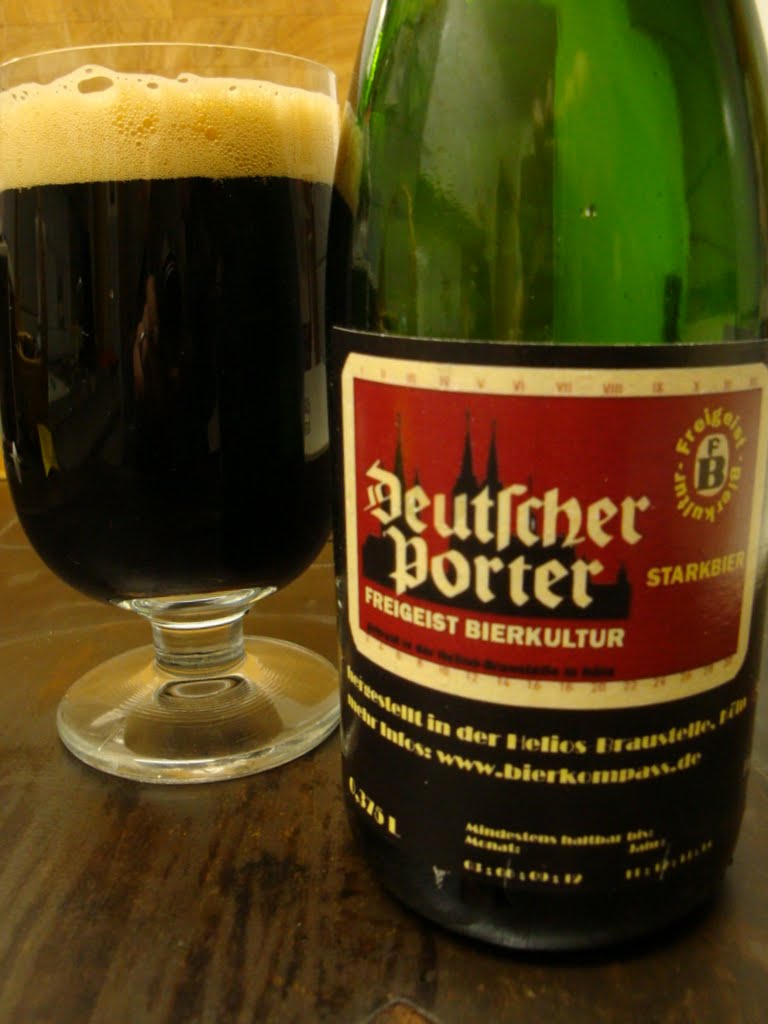
And what better way to get back into the swing of things than a German porter, apparently brewed to a style previously made in the DDR (but I have to take their word on that).
Freigeist Bierkultur have an interesting range of beers, all brewed at the Helios Braustelle in Cologne, hosts of the Festival der Bierkulturen. Their Deutscher Porter is no exception, at least from the description. The ingredients include salt, and brettanomyces is involved in the fermentation process. Pouring an opaque black, with just the faintest traces of ruby highlights around the edges, this 8% ABV porter hints at soft vanilla toffee, light coffee, licks of licorice and a squeeze of soft summer fruits on the nose. All quite toned down, but there nonetheless. So it was quite a kick in the teeth when the first mouthful delivered not a rich, full-bodied, fruity, chocolatey porter, but a bite of a lemon. It's sour. Not Cantillon sour, but significantly so nonetheless. It's refreshing. The expected roasty or chocolate flavours are playing sixth fiddle somewhere, but the fruits, raspberry and green apples perhaps, creep out from under the lemon to leave a pleasing tartness on the tongue. A slight oiliness at the back of the throat may come from the salt, but it's hard to say where that comes in to play.
Freigeist's Deutscher Porter puts me in mind of De Dolle's Cosmos Porter, but sadly doesn't reach the same levels of complexity. A one-trick pony? Perhaps, but it's a lovely, surprising beer all the same, and shockingly easy to drink, the light body belying the relatively hefty alcohol content. In fact, when I think of other German beers with that level of alcohol, the drinking experience couldn't be more different, and for that, I salute them.
Wednesday, 30 November 2011
Saturday, 30 April 2011
Blind tasting Alpirsbacher Ambrosius
Two weeks ago, after a couple of days in Bamberg with two of my oldest friends from Ireland, and on the eve of my Birthday, we had an ideal opportunity to put a bottle of Alpirsbacher Ambrosius -- a new German Tripel released shortly before Christmas 2010 and the first of two German Tripels I came across since, the other being being the Franz Anton Schäffler Triple -- through its paces against a couple of Belgian Tripels and a German wildcard in a blind tasting.
After a couple of days in Bamberg, this was going to be kill or cure, but we were dedicated.
Beer A I found had a warm, sugary, toffee-apple aroma. the first taste also felt warming, with big, soft raisin flavours. Somewhat thin on the mouthfeel, sugary malts up front, a light fruitiness, suggesting raisins, cut short by a pine-like bitterness that hangs around for quite a while. In summary, sugary, fruity, with a little too much residual sugars for my liking, but with a pleasant warming effect.
Beer B had very little aroma, and what it delivered was more along the lines of alcohol, with slight marker/acetone notes. Light and alomost wine-like, with a grape skin tannic edge bringing up the rear. Slight bitter almond/marzipan traces.. Overall, fruity in a grape-like way, juicy and a crisp tannic finish that I liked.
Beer C had similarities to B in many ways, but it upped things on the fruitiness. Pears, apples, oak-like vanilla notes. Dry, almost cranberry-like in the feel, but buffered by a light candy-like middleground. Quite an assertive bitter finish, with that dryness pushing a herb-like (it had me in mind of thyme or oregano) bitterness well to the front of the tongue. Overall, crisp, dry, nice fruity, orangy notes. My favourite of the four.
Beer D reeked of corn. That boiling corn on the cob kind of aroma. Really off-putting compared to the other three. Sugary to the taste, but with a cleansing German hop character, citric?lemon and slightly herbal. A pleasant warming pepperiness to the finish. Overall, like sweetcorn with hops.
I knew what the four beers were, so was the only one able to take a guess what each was. As it turns out, I was able to name all correctly.
Beer A: Alpirsbacher Amrosius
Beer B: St. Bernardus Tripel
Beer C: Westmalle Tripel
Beer D: Andechser Bergbock Hell
The reasoning? D was clearly the odd one out. It had to be the Doppelbock. It was included on the off chance that the Ambrosius bore more resemblance to its German brother than the Belgian cousins. Definitely not! The Ambrosius stood out in that it had a malty sweetness (sorry Mark) that just made it typically German to me. It's hard to get a strong German beer that doesn't have a sugary consistancy, and this had at least hints of that. B and C felt more refined to my taste, so had to be the Belgians. C stole it for me, so I subconsciously assumed it to be the Westmalle, as I hadn't tried the Bernardus Tripel before.
In the end, the Ambrosius is a fine beer, but to my taste, it doesn't come near the surprisingly crisp and refreshing levels that the Belgians hit, even with beers at that level of alcohol. Also, it's not bottle conditioned. Not a trace of yeast in the bottle, so I'm not sure I hold much hope for my remaining bottle developing much in the cellar. Time will tell.
After a couple of days in Bamberg, this was going to be kill or cure, but we were dedicated.
Beer A I found had a warm, sugary, toffee-apple aroma. the first taste also felt warming, with big, soft raisin flavours. Somewhat thin on the mouthfeel, sugary malts up front, a light fruitiness, suggesting raisins, cut short by a pine-like bitterness that hangs around for quite a while. In summary, sugary, fruity, with a little too much residual sugars for my liking, but with a pleasant warming effect.
Beer B had very little aroma, and what it delivered was more along the lines of alcohol, with slight marker/acetone notes. Light and alomost wine-like, with a grape skin tannic edge bringing up the rear. Slight bitter almond/marzipan traces.. Overall, fruity in a grape-like way, juicy and a crisp tannic finish that I liked.
Beer C had similarities to B in many ways, but it upped things on the fruitiness. Pears, apples, oak-like vanilla notes. Dry, almost cranberry-like in the feel, but buffered by a light candy-like middleground. Quite an assertive bitter finish, with that dryness pushing a herb-like (it had me in mind of thyme or oregano) bitterness well to the front of the tongue. Overall, crisp, dry, nice fruity, orangy notes. My favourite of the four.
Beer D reeked of corn. That boiling corn on the cob kind of aroma. Really off-putting compared to the other three. Sugary to the taste, but with a cleansing German hop character, citric?lemon and slightly herbal. A pleasant warming pepperiness to the finish. Overall, like sweetcorn with hops.
I knew what the four beers were, so was the only one able to take a guess what each was. As it turns out, I was able to name all correctly.
Beer A: Alpirsbacher Amrosius
Beer B: St. Bernardus Tripel
Beer C: Westmalle Tripel
Beer D: Andechser Bergbock Hell
The reasoning? D was clearly the odd one out. It had to be the Doppelbock. It was included on the off chance that the Ambrosius bore more resemblance to its German brother than the Belgian cousins. Definitely not! The Ambrosius stood out in that it had a malty sweetness (sorry Mark) that just made it typically German to me. It's hard to get a strong German beer that doesn't have a sugary consistancy, and this had at least hints of that. B and C felt more refined to my taste, so had to be the Belgians. C stole it for me, so I subconsciously assumed it to be the Westmalle, as I hadn't tried the Bernardus Tripel before.
In the end, the Ambrosius is a fine beer, but to my taste, it doesn't come near the surprisingly crisp and refreshing levels that the Belgians hit, even with beers at that level of alcohol. Also, it's not bottle conditioned. Not a trace of yeast in the bottle, so I'm not sure I hold much hope for my remaining bottle developing much in the cellar. Time will tell.
Monday, 11 April 2011
Braufactum Darkon, Roog and Indra.
A little while ago I mentioned the very attractively packaged, own-branded beers from BraufactuM. This was in the context of exclusivity, as the presentation, and the price of these beers seems aimed at a particular type of person. But are they any good? I was lucky enough to have the chance to take three of their beers for a little taste drive.
BraufactuM Darkon is described as an "elegant Schwarzbier" at 5.4% ABV. It has a light roast and toffee aroma, with some fruitiness. The initial impression on the flavour is that of a thin malt drink with a pleasant raisin fruitiness with light coffee and chocolate notes. Remarkably floral at the back, it delivers a pronounced herbal bitterness, washed away by thin caramel flavours. It's nice that this bitterness gives a sharp contrast to the sweet and roast flavours, but it ends on a bit of a bilious sour note. Better when drinking, and not good to stop so. Interesting, but not a balance of flavours that works for me. Well, not the sick.
Their Roog Rauchweizen raises the ABV to a respectable 6.6%, and pours dark, muddy brown. It delivers a light smoke aroma, gentle, but certainly present, on top of a classic Weizen banana-like foundation, combining into a smoked-fruit effect. Rather good! If has a soft, juicyfruit/bubblegum and strawberry-like flavour, with a spritzy carbonic bite, followed by a very pleasant, sweet smokiness. Well-balanced and hitting all the classic Weizen buttons with the added dimension of smoke, I have to say, this is the best Rauchweizen I've had. Others, including the more famous ones from Schlenkerla and Spezial, just didn't get the balance right, in my mind. Lovely.
And on to the BraufactuM Indra, a 6.8% Weizen India Pale Ale. I was looking forward to this one most, to see what a German interpretation, including Cascade hops, would turn out like. With a lively carbonation and that orange hue, it looks every bit the Weißbier, but that's where it stops. I have to admit, my first impression was Wow! A huge grapefruit aroma leaps out from under that dense, fluffy head. It has an interesting mix of flavours. The hops elements are way to the fore, with grapefruit and lemon banging it out. There's a grainy middleground, somewhat mealy, but with a robust fruitiness suggesting orange, pears and a light caramel. I'm not sure what yeast was used, as it has none of the hallmark Weizen flavours that I expected, but perhaps it just makes heavy use of wheat. I have to admit, I made no other notes as it was a complete distraction of a beer.
So, are they worth it? Well, that depends. Flavour-wise, I was really impressed. The Roog, at €4.99 for 330ml was the first Rauchweizen I tried that I felt really worked, and it exceeded expectations. Similarly, I’m a big fan of the American interpretation of IPAs, and the Indra checked all of the boxes, and then some. Simply brilliant. But at €5.99 for 330ml, I simply cannot justify that as a regular purchase, especially as it is most likely made locally. Sadly, that means that while at best, they may expect an occasional purchase for curiosity, they won’t be getting regular custom from me (sad for me too!). I can’t help wondering if this kind of pricing is shooting themselves in the foot, but then there will always be someone with more money than sense.
Many thanks to my friend and whisky pimp, Rüdiger, for sharing these with me. I'm tempted to try more.
So, are they worth it? Well, that depends. Flavour-wise, I was really impressed. The Roog, at €4.99 for 330ml was the first Rauchweizen I tried that I felt really worked, and it exceeded expectations. Similarly, I’m a big fan of the American interpretation of IPAs, and the Indra checked all of the boxes, and then some. Simply brilliant. But at €5.99 for 330ml, I simply cannot justify that as a regular purchase, especially as it is most likely made locally. Sadly, that means that while at best, they may expect an occasional purchase for curiosity, they won’t be getting regular custom from me (sad for me too!). I can’t help wondering if this kind of pricing is shooting themselves in the foot, but then there will always be someone with more money than sense.
Many thanks to my friend and whisky pimp, Rüdiger, for sharing these with me. I'm tempted to try more.
Friday, 1 April 2011
The Session #50: How do they make you buy beer?
A few weeks ago, I put forward my thoughts that the general lack of variety in German beer was not so much to do with the Reinheitsgebot as with the general conservativeness of the German public at large. Basically, despite the fact that the Reinheitsgebot allows for a massive variety of beer styles, they generally don’t go too far in Germany (and I acknowledge gratefully the likes of Altbier, Kölsch, Rauchbier and other regional specialties). But when there is something clearly different to the norm, how does the Brewery or beer seller try to tempt the regular German public to make that leap beyond Pils and Helles? Exclusivity seems to be the keyword, at least when the marketers are involved.A little while ago, I mentioned Alpirsbacher Ambrosius, a German-brewed Belgian-style Tripel which, as one regional paper put it, was the most expensive German beer available. It was described as a “gourmet” beer, and much was made of the fact that cork and cages were used, presumably adding to the desired comparisons with wine. At €8.60 for 750ml, it’s not prohibitively expensive, and certainly not the most expensive German beer I’ve seen to date, with that honour belonging to the Schorschbräu 32 or 43, retailing at about €60 for 330ml. At least in that case, production was extremely limited, and a lot of materials and man-hours went into creating a one-off, but I digress. The point is, the exclusivity and “specialness” of Ambrosius were used to try and make people buy it. Although it disregards the fact that the Trappists were doing this for some time, bear in mind that it’s pretty hard to find such beers in German stores, so yes, in a way it’s “new” 'round these parts, and this apparent uniqueness in itself is a draw to purchase. Does it taste any good? Is it worth the cash? Well, time will tell, I’ve got two bottles of Ambrosius in the cellar, waiting for an opportune moment to blind taste against a Trappist beer and a few others, so at least that trapped me!
Really pushing all the exclusivity buttons is BraufactuM. Their website features a small selection of beers form Brooklyn, Marston’s, Birrificio Italiano, Birra Baladin, and their own BraufactuM label. It’s beautifully presented, with the menu split between “courses”, sumptuous images of the beers, tasting notes and detailed information on the ingredients. Really, this is the way beer information should be given, but the work that went into this could only be possible with the small selection presented. Put it this way, it really made me want to buy them all! But! The prices!
Their own label, brewed at an unknown location, includes some really great-looking beers, Indra, a Weizen India Pale Ale, Roog, a smoked Weizen and Darkon, a Schwarzbier, all relatively reasonably priced, while still oozing exclusivity due to the classy packaging (thanks to a friend, I tried all three of these two nights ago, but I’ll return to those in a later post). But I balk at paying €17.99 for a 330ml bottle of 13% Arrique barley wine (€54 per litre)! I mean, made with local ingredients, how can it be that expensive? That’s where style and exclusivity can stay out in the cold.
But what is it like? If you weren't being swayed by the classy label, and the most advanced corking system you've ever seen (the Zork Cork), would it taste as good? Blind tasting time! Three of us put the F.A. Schäffler Triple against the Härte 10... well, Tripel.
Beer A for me had a broad, sweet, fruity aroma, I want to say lychees, but that sounds pretentious. Bubble gum, with aged red apples. The flavour is really candy-like, with pear drops and an amplified juicyfruit chewing gum and banana. Very sweet and sticky though.
Beer B was very similar in many of the core flavours, but different enough that we all noticed it. For me, it was a bit thinner, a little sharper, and had more brown sugar than a load of candy, and a pineapple like edge.
All in all, I preferred B. Though both shared common elements, I felt B was more refined, and because of that, I declared that it was the more expensive of the two. I was wrong, and so was my colleague, Rüdiger.
If they are the same beer, and I think there was enough in common for me to believe that, I wonder what made them different. Age, storage, all of that could play a part. Maybe the batches that don't meet a standard get rebadged? The main thing is, if they are the same, how can this price differential be explained? I can only think it's the aura of exclusivity you're paying for, and that alone can be enough to make you want to buy a beer, despite being an otherwise clear-thinking human being.
And I have another bottle of each!
*Their website doesn't work, but they do list Schäffler-Bräu
Thursday, 17 March 2011
Irish beer today. Not the usual stuff.
Around the middle of March, Irish people get stuck into a little bit of navel gazing, and papers are filled with articles assessing how the rest of the world views Ireland. These days, most might refer to the current economic plight of the Nation, but invariably, people abroad often express their thoughts of Ireland in terms of the craic, and “the beer”. Of course, in Ireland’s case, “the beer” might as well be singular, as the iconic pint of the black stuff is like an avatar of Irishness the world over.
Of course, it wasn’t always like that. In the early 1800s, Ireland was scattered with breweries and distilleries, and at least every small town seemed to have at least one or the other (we’ve already identified over 160 breweries from the 1830s). By the 1960s, most were gone, bought out and turned from being independent producers of beer, into bottlers under the yoke of one of the big breweries. In places like Dublin and Cork, choice held out for as long as it could for the discerning customer, until eventually, the likes of Phoenix, Anchor, Sweetman, Findlaters, Manders and Thunder were undercut, shut down, bought out, assimilated or built over by the big brewers. By the 1950’s, Dublin had gone from over 22 breweries to 1. Cork went from over 25 to 2, and now, even one of those has gone. And that is how everyone else now sees “the beer” in Ireland. A monoculture, owned by large international corporations. The most Irish thing about these beers is the history, and the shamrockery branding.
But of course, things change, and in typical Irish fashion, there were small revolutions, when forward-thinking Irish men and women sought choice and quality. In the early-to-mid 1990s, a first, small wave of Irish micro breweries made brave moves against the tide. One has to admire them, putting small, often two or three-man operations against the incumbent powers that be. For some, the introduction of staged tax rates on brewers came too late, and the likes of the Dublin Brewing Company, North King Street - who reintroduced D’Arcy’s Stout to Dublin after the the original Anchor Brewery succumbed to the onslaught of the bigger brewery in 1926 - repeated history, and could not continue to fight against the status quo. Others, like Biddy Early, fell by the wayside, as Irish people chose to stay with the brand they knew best, regardless. But some, like The Porterhouse, Franciscan Well and Carlow Brewing, thrived, a testament to their bravado and business acumen.
In the last few years, a second wave has begun, with the likes of the Hooker Brewery, first bringing their pale, hoppy ale, Galway Hooker, to punters in Galway in 2006, and quickly spreading to other parts of the country (something I was very glad of, as it became my regular tipple when (frequently) out in Dublin). Even over the past year, there’s been several new breweries, including Dungarvan, Trouble and Metalman, all operated by small groups of family or friends who brewed at home, and all taking the big leap into commercial brewing. It's both a sad indication of the near-death experience of Irish brewing and a thrilling feeling of rejuvenation, that we now list 15 microbreweries on the island of Ireland, when about 20 years ago there were just three massive brewing companies present.
What these breweries have in common, is first and foremost a love of the beer, and drive to bring new tastes to the Irish drinking classes, although often with a nod towards what is considered traditional for Irish beers. It is this spirit that Beoir encourages, just as it encourages people to try them out, and see what wonderful Irish taste experiences are sitting behind the bar, or on the supermarket shelf.
The main thing is, in times likes these, if you want to celebrate Irishness with an Irish beer, why not pick out a beer that has been hand-crafted, with love and pride, by a small Irish company. Give something back, help these small businesses, and enjoy something that is delicious, top quality, and actually Irish-owned.
Of course, it wasn’t always like that. In the early 1800s, Ireland was scattered with breweries and distilleries, and at least every small town seemed to have at least one or the other (we’ve already identified over 160 breweries from the 1830s). By the 1960s, most were gone, bought out and turned from being independent producers of beer, into bottlers under the yoke of one of the big breweries. In places like Dublin and Cork, choice held out for as long as it could for the discerning customer, until eventually, the likes of Phoenix, Anchor, Sweetman, Findlaters, Manders and Thunder were undercut, shut down, bought out, assimilated or built over by the big brewers. By the 1950’s, Dublin had gone from over 22 breweries to 1. Cork went from over 25 to 2, and now, even one of those has gone. And that is how everyone else now sees “the beer” in Ireland. A monoculture, owned by large international corporations. The most Irish thing about these beers is the history, and the shamrockery branding.
![]() |
| The Anchor Brewery, Dublin, c. 1889. |
But of course, things change, and in typical Irish fashion, there were small revolutions, when forward-thinking Irish men and women sought choice and quality. In the early-to-mid 1990s, a first, small wave of Irish micro breweries made brave moves against the tide. One has to admire them, putting small, often two or three-man operations against the incumbent powers that be. For some, the introduction of staged tax rates on brewers came too late, and the likes of the Dublin Brewing Company, North King Street - who reintroduced D’Arcy’s Stout to Dublin after the the original Anchor Brewery succumbed to the onslaught of the bigger brewery in 1926 - repeated history, and could not continue to fight against the status quo. Others, like Biddy Early, fell by the wayside, as Irish people chose to stay with the brand they knew best, regardless. But some, like The Porterhouse, Franciscan Well and Carlow Brewing, thrived, a testament to their bravado and business acumen.
In the last few years, a second wave has begun, with the likes of the Hooker Brewery, first bringing their pale, hoppy ale, Galway Hooker, to punters in Galway in 2006, and quickly spreading to other parts of the country (something I was very glad of, as it became my regular tipple when (frequently) out in Dublin). Even over the past year, there’s been several new breweries, including Dungarvan, Trouble and Metalman, all operated by small groups of family or friends who brewed at home, and all taking the big leap into commercial brewing. It's both a sad indication of the near-death experience of Irish brewing and a thrilling feeling of rejuvenation, that we now list 15 microbreweries on the island of Ireland, when about 20 years ago there were just three massive brewing companies present.What these breweries have in common, is first and foremost a love of the beer, and drive to bring new tastes to the Irish drinking classes, although often with a nod towards what is considered traditional for Irish beers. It is this spirit that Beoir encourages, just as it encourages people to try them out, and see what wonderful Irish taste experiences are sitting behind the bar, or on the supermarket shelf.
The main thing is, in times likes these, if you want to celebrate Irishness with an Irish beer, why not pick out a beer that has been hand-crafted, with love and pride, by a small Irish company. Give something back, help these small businesses, and enjoy something that is delicious, top quality, and actually Irish-owned.
Thursday, 3 March 2011
Maybe it's not the Reinheitsgebot. Or is it?
Last night, a friend on Beoir sent me a link to an article on The Slate, by Christian DeBenedetti, that describes the decline of German beer culture. I think it's fair to say that it's written from an American perspective, at least some of the tone is, how shall I put it, celebrating the US role in the current beer universe. Regardless, it's hard to argue with the figures, tallying as they do with those I read in the regional daily a few weeks ago. Beer consumption is on the decline in Germany, and all sorts of reasons are given in the broadsheets; the changing demographic, with the aging population naturally drinking less, but with the younger people drinking differently, not taking up the beer glass.
One thing about DeBenedetti's piece had me nodding straight away was the concept that the Reinheitsgebot is stifling German beer, much in the same way that it wiped out the rich variety of beers that existed prior to the Bavarians insisting the 'gebot be taken on as a condition of unification in 1871. I've gone on a bit about that myself, with the occasional uncharacteristic rant, but I began thinking, much as I have disliked the Reinheitsgebot (and I do think it's bollox), it's not really the law itself that irritates me, but the way it's used, and the way it has insinuated itself into the psyche of the average, beer-drinking German.
A bad workman blames his tools, and I'm beginning to think that it's easy to point to the Reinheitsgebot and say "Look! It's a straitjacket, and the German breweries are stuck in 1516! There's no innovation, and they're being left behind." For the beer aficionado, it's easy to look to the US, the UK, Sweden, Italy, all sorts of places, stroke one's chin(s) and decide that Germany is a basket case. Maybe it is. The fact is, there's masses of room for innovation, even staying within the strictures of the Reinheitsgebot. Brewers don't even have to stay within the limits if they don't want to. The thing is, they like to, which is fine, but by choice, the majority of small breweries in Germany produce the same thing as every other small brewery. A pils, a helles, a dunkel a weissbier. Why? The Reinheitsgebot doesn't make them do that.
Perhaps it's a more general societal thing. Germany is pretty stable. One might say even boring, where they need the likes of Carneval/Fasching as an almost State-sanctioned reason to dress up, go out, get drunk and make an arse of themselves. Could this stability simply be manifesting in liquid-form as the staple beer types? Are the majority of German brewers simply just playing it safe? What does this lack of innovation have to do with the Reinheitsgebot at all? I'm beginning to think nothing at all. Is it because they are afraid, or because they know the average German beer drinker likes it that way? I know it's hard to sell the idea of non-German beer to Germans, but I found that most people are like anywhere else. Once they try it, they'll be intrigued by different flavours. Without something in your hand to get them to try, you're wasting your breath, and you will get the occasional sneer of "that's not beer".
So, is it the people that are stifling change in German beer culture? Perhaps. Why? Because they believe in the Reinheitsgebot? Maybe. Would a regular person care as long as they have a tasty beer in their grubby paws? Not likely.
There is innovation though, if you know where to look. But perhaps not as much as I'd like to think. I thought it was quite damning that DeBenedetti mentions the likes of the Weyermann pilot brewery and Cologne's Braustelle, and to realise I've tried all of these. In fact, that little event organised by Braustelle last year had most of them gathered together (and many were quite delicious). I began to wonder if DeBenedetti had been to the same event or read my blog. Is that the limit of "innovation" or rather, reaching out? No, there are others. Andreas Gaenstaller and his wonderful Affumicator, some small breweries in Berlin putting erstwhile verboten ingredients in their beers (no idea if they're any good though), new abbey beers, albeit conforming to the Reinheitsgebot. I'm sure there's more, but even with a declining number of breweries (and that it by no means new, as two decent-sized breweries closed down in the late 80s/early 90s where I live), there's a hell of a lot to get through, and these small breweries don't get the 15 minutes of fame, or longer, that the "hot" breweries of the US and UK get.
Jeff Pickthall made a good point: "at least German mediocrity is of a higher standard than British mediocrity. I'll give them that." A bit strong perhaps, but in the main, and despite the horrendous sameness that at first glance pervades the brewpubs of Germany, this country still provides the world, and the drinking classes, with some damn fine, refreshing beer. Long may it continue.
Monday, 21 February 2011
The Rochefort Files
Luckily, thanks to the likes of Bier Zwerg, I can buy these kinds of beers, even in a place like Germany where it's really hard to find such "exotics" (bearing in mind I now have a couple of bottles of the new Ambrosius).
Makes sense to start with the baby, Rochefort 6, though a chubby kid at 7.5% . A chestnut-tinged amber with a few motes of yeast in suspension and pretty sprightly carbonation helping deliver a creamy head. An odd aroma, slightly soapy, light pine and hard pears. Inviting, nonetheless. It sits easily on the tongue, all light caramel, sweet orange marmalade and raisins. A little thin perhaps, considering it's weight, but its long, fruity, raisiny and warming finish makes it a simple pleasure.
So much so, that by the time I got to the Rochefort 10, I was tucking into bread, cheese, salamis and hot mustard, a perfect combination with these beers, and I really wasn't bothered taking any more notes, so with a fresh palate, I sampled the 10 anew the following evening.
Of the three, I think my preference is ever so-slightly towards the Rochefort 8, but both it and the 10 will find a semi-permanent place in the new cellar.
Oh, and I can't drink a bottle without this going on in my head.
For bonus material, especially if you remember the start of the show, check out this answering machine message collection! :)
Subscribe to:
Comments (Atom)


