Showing posts with label The Session. Show all posts

Friday, 28 February 2025

The Session #144: The best beer I can drink at home right now

0 comments

It feels a bit odd putting words down about beer again. Cider and perry and trees and orchards have taken over my complete attention for the past few years. Any writing I have done – and I feel I’ve done a lot, yet somehow not enough – has been on those topics, usually over at Cider Review, of which I ended up be co-editor last year.

But despite having literally thousands of litres of cider and perry in the cellar, I am still very much a beer drinker. I drink far more beer than I do cider or even my beloved perry, as it is beer that I reach for at the end of a day’s work, the almost ritualistic Feierabendbier of German culture.

What has changed in recent years, though, is that I have lost the desire to constantly chase new beers. I suppose it's a side-effect of living in a small German village that has one small drinks store that sells regional and "TV" beers by the crateload, and an EDEKA supermarket where the most exotic beer is probably Kilkenny. Here, one must put in the effort of searching and ordering online if you want anything out of the ordinary. And if you feel out of touch, as I surely do now, facing a virtual wall of brightly coloured cans and bottles can sometimes lead to decsion paralysis, at least for this brain.

So it is to the ordinary that I have gravitated in recent years. At least ordinary for around here. Sure, I will occasionally order a big mixed box of German pale ales or IPAs, or the occasional pack of Rodenbach. And if I am travelling (a lot less than I used to), I will always seek out bars with an interesting selection and sample through as much as I can.

But in the comfort of my own yard, or stepping around to a neighbour for a chat, or dropping into that small drink store around the corner, where men gather of an evening, either outside on the bench when it is sunny, or inside, sitting in crates which have had plyboard tops made for them to avoid a bottle up the arse, the choices are usually pretty easy for me. The patrons know what to pass me when I come in.

I am never without these two beers in my cellar. I can go down right now and make the choice between the two. Sometimes I have the option of choosing between a 330ml or a 500ml bottle of the same beer. It’s good to have variety after all. For me, they are the best beers I can drink right here, right now, and if I look at my social media feed (now solely Bluesky), it will nearly always be one of these two that is pictured in my hand at the end of a working day.

Herbsthäuser Edelpils and Distelhäuser Pils.

Both are fairly local, certainly regional beers, from medium-sized privately-owned breweries. 

If I want something more floral-toned, brighter and hop forward, I’ll pick the Distel. 

If I want something with a little more malt-toned backbone, perhaps a little more chew to it, I’ll pick the Herbsthäuser. 

On reflection, it’s more often the latter at the moment, but I have phases. In short, they are both really great beers that you can just simply enjoy, süffig, and definitely the best beers I can drink at home right now. I bet if they were suddenly made more widely available, they would do very well in other lands. But I'm glad to have them in my cellar.


Friday, 6 May 2016

The Session #111: Beer midlife crisis?

2 comments
I'm about the right age for a midlife crises, if such a thing exists, but our host, Oliver, wants us to focus on the idea of a beer midlife crises, something that I can probably relate to in one sense or another.

If this blog, and the (in)frequency of posts over the past few years is anything to go by, it would sure look like I lost the zeal for good beer. But for many, and I would include myself in those ranks, blogging is just an aspect of a hobby, a means to engage with a broader, international community of beer lovers. For others, it is a means to establish a brand, to launch into something closer to a job in the industry, as many of the new, glossy-looking German blogs seem to be, riding on the wave of a new German beer (sub) culture.

Truth be told, I had more pressing things to be doing, renovating a house, taking care of my family, and fitting into the new social dynamics of a small German village. But I will admit that over this period, while my core love of beer smoldered away inside, I was quite content, in the main, to buy beers I liked by the crate-load, and simply enjoying them without analysing. My home brewing was taking a hit, too, with a low point in 2012 of brewing only once in the entire year! And apart from the highlights of attending a festival or two each year, I had neither the time nor the money to be investing in what can be an expensive hobby. At least when trying to keep up with the new, usually dearer, specialty brews from new and old breweries here, while there were pretty decent "normal" beers to be had at very reasonable prices. So my broader explorations slowed, and I had to become more selective.

This period also saw a boom in what I suppose can be described the craft beer movement here in Germany. With my lack of time and money, to a degree it felt like watching from the outside, as the choices for lovers of interesting beer expanded, and the idea of craft finally came to Germany. However, observing an apparent swell of "me too" breweries, or often just brands opening up in the trendy parts of Germany, as well as large breweries co-opting the "movement", I think I probably reached, well, not a crises, but a kind of cynicism that is not really the way I like to see the world.

And that is probably as close to a crises that I will get in my beer life. The pleasure of experiencing a new beer, for brewing, for sharing and for actually being part of a community with a common interest, well, that never went away.

In the past 14 months, since moving into our house, my home brewing has increased pace again, and brew days have become more like a social occasion, as people usually pop around for a bite to eat and some beer tasting. I'm also planning on giving the home brewery a more permanent home in the barn, one of the many projects on my endless to-do list. Last August I completed a dedicated beer cellar, and plan to start cellaring certain beers properly, with a view to having vertical tastings in a few years, so the way I see it, beer has been incorporated into the very fabric of our home.

The social aspects of beer are also too important to forget. For me, beer has been like an "in", as a foreigner in a small village. Stammtisch people now introduce me as "the Irish brewer", if someone new pops in, giving two topics to immediately talk about. But more recently, my passion for all things beery has been re-awoken due to being around more people with similar interests, either home brewers, professional brewers, or simply neighbours of all ages just happy to objectively taste something new. Beer is ultimately a social thing, and it needs people to make it any way interesting at all.

I won't promise that this blog will suddenly be seeing more regular posting, nor am I ready to close its eyes and draw a blanket over it, as TheBeerNut put it. I will continue to occasionally post about things that grab my fancy, or that I feel need a bit of thought and exploration (purely for my own sake), or simply giving readers a view into what is happening in the German beer scene. But my personal interest in beer? That won't lessen any time soon. It's simply too much fun!

Friday, 3 July 2015

The Session #101 - The material culture of brewing

4 comments
This month's Session is hosted by Jack at Deep Beer, who chose the topic “bottles, caps and other detritus”, a topic that seemed strangely apt for me, as Boak and Bailey kindly pointed out via Twitter, considering some of the stuff I had been tweeting about over June.

I'm not a collector by nature. At least I try not to be, despite a small weakness for beer glasses and bottle openers. When people hear you are a beer geek, they tend to dump their own junk on you, which is fair enough, and I can (and do) filter, and keep what I like, so the “collection” stays manageable.

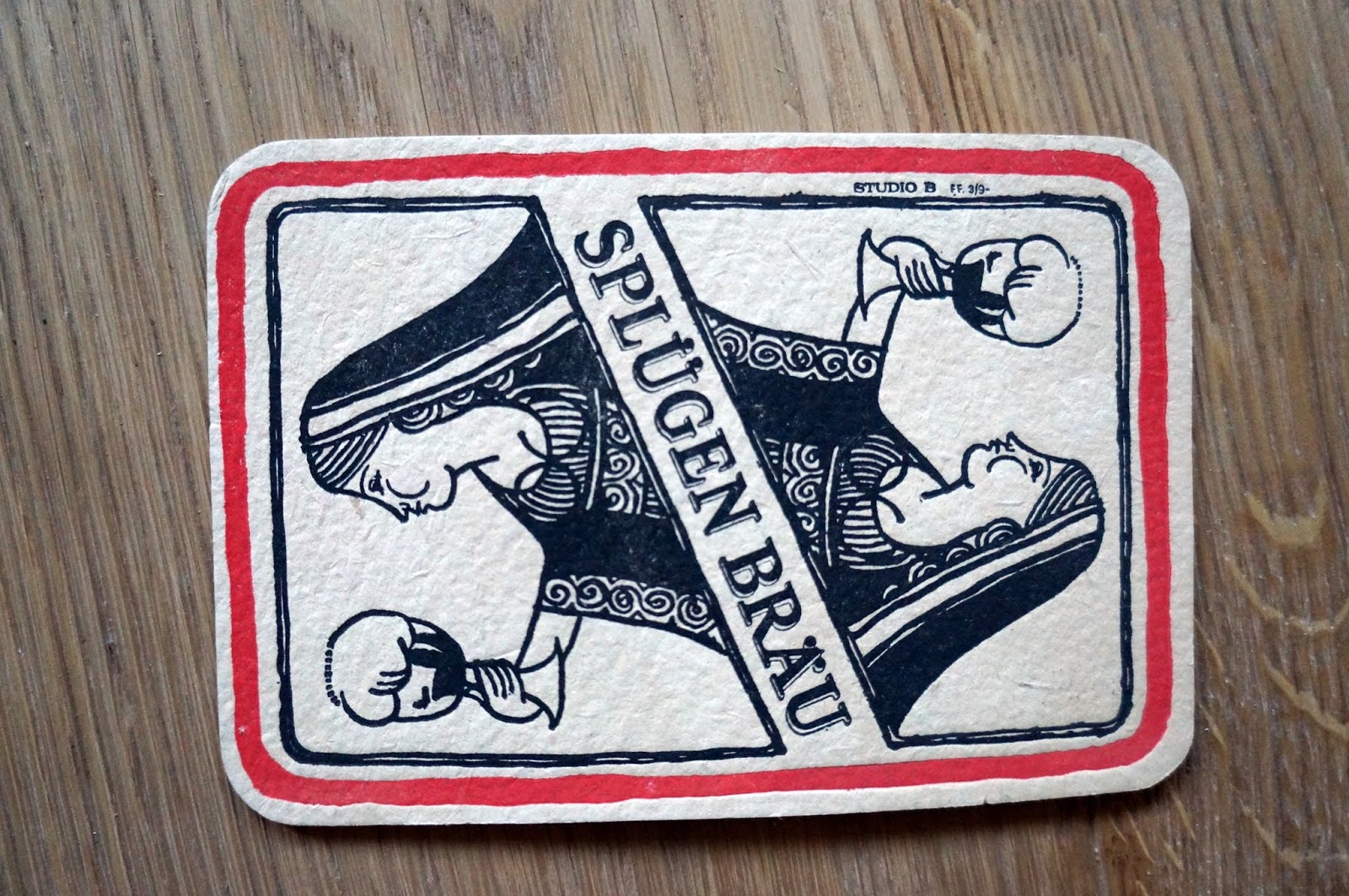
However, last month, while visiting a garage sale, when I mentioned I was interested in beer glasses, the owner's daughter asked if I would be interested in a box of beer mats (coasters) from the 60s and 70s. Normally I would say no, but what a box! She said around 1,400 beer mats, and lying on top was a Double Diamond mat, so I said sure I'd take it! She offered to give it away for nothing, as her parents were trying to clean out before moving down to Lake Constance, but with her Dad looking on, I felt a bit bad about that, so offered a tenner for the lot plus a Distelhäuser Maß Krug. I promised to look after them well, and with that, we were off home.

The box was filled with bundles of mats wrapped in newspaper, mostly dating from 1964, which suggested we were dealing with slightly earlier mats than suggested. My wife, being the archaeologist with archiving experience, pretty much took over at this point, and has since sorted the collection into groupings by country then city/town. Of course, the majority are German, with a few hundred international examples, a large portion of which are from Alsace. But the total number was also higher than expected, with circa 2,200 mats, mostly from the late 1950s and early 60s.


But what to do with them? My son says this means I have to open a bar, though all agree at least a portion should be put on display somewhere, but for the moment, they will probably reside, neatly sorted, in old, stackable plastic mushroom boxes, waiting for their moment, however, the act of sorting and looking was already a fun excercise.

I said I was not a collector, but my wife is. I am a beer afficiando, my wife is not. But a collection like this overlaps both interests. I would stand, looking at these mats from breweries long gone, some of them quite local, wondering what  the beer was like. Meanwhile, my wife was constantly pulling up facts about the towns where the breweries were located, how many breweries they once had, when they shut down, when they became better known as another name, or when they got taken over. Real, living history, all laid out on our guest room floor.

There's lots of ways to filter and consider such collections. The obvious is of course the breweries themselves. Indulge me a moment, and we'll taker a look at a local example.

In the 19th century, my wife's home town of Mosbach had up to 13 breweries in operation. Now, it’s almost hard to believe, as there’s only one in operation now, and it’s a brewpub.

The biggest one was Brauerei Hübner, which began operation in 1878 when Heinrich Hübner bought out the former Brauerei Heller. In 1896 there were further consolidations, and they subsumed Brauerei Schifferdecker, to form the Mosbacher Actienbrauerei. With that latter takeover, the Deutscher Hof inn was added to their holdings. This building, which I believe was attached to the brewery complex proper, is the only part of the brewery that still exists, now as the restaurant/bar Ludwig, at the end of the pedestrian zone in Mosbach.


A set based on a road sign theme.
The fronts of the two series above.
One of the newspaper wrappings had a Hübner ad.
By the early 1900s, the Hübner family was clearly doing well. Between 1900 and 1902, they built a large sandstone villa overlooking the town, with large gardens behind it. In 1908, the massive malthouse was constructed. This remained in operation till the 1960s, when it was producing up to 4000 tonnes of malt annually.

20th Anniversary celebrations at Hübner. Heinrich Hübner is 2nd from left.
In 1928 they renamed back to Brauerei Hübner, and continued operation till 1983. After the closure of the brewery, the malthouse was abandoned, and since 1997, this protected structure has been used as a cultural and conference centre. The villa is still standing, although the gardens are now part of a shopping centre, and the brewery site has largely been replaced by a multi-story car park, apart from the Ludwig bar, as mentioned above.

Hübner is certainly not so long gone that it doesn’t survive in living memory. My wife has clear memories of them as a teen. But now, it’s just those memories, and the physical remnants. We've plenty of documentation to sieve through, so I hope to find out more about what they brewed, and how much of it.

Another way to filter the view on such a collection of beer mats was discovered when we unwrapped one particular bundle, where most of the mats were from the 1958 World Expo in Brussels. This little package was like a time capsule, capturing a distinct moment represented by several breweries and indeed other companies like Sebena Air, that were most likely all exhibiting at this world event. It was like a horizontal tasting of beer mats, as opposed to the vertical view given by a single brewery over time.

A bunch of mats from the 1958 World Expo in Brussels.
These mats – and the glasses and signs that still decorate bars around the world – all represent a material culture of breweries, many long gone. They have a permanency that the beer, the lifeblood of the breweries that they represent, could never have. Thinking about it this way, they are definitely worth keeping and documenting. If nothing else, it's just a wonderful way to learn the story of breweries, past and present, and it's down to individuals to help preserve the knowledge of their local breweries.

The next time you are sitting in a bar with the walls festooned with signs, labels and beer mats from old breweries, just consider the heritage that forged them, where they came from, and the giants upon whose shoulders our current beer culture stands.

Postcard beer mat from the 1958 World Expo

Another postcard beer mat.

*Addendum: the collection currently represents 501 breweries

Friday, 3 April 2009

Smoking Virgins

6 comments
I'm a fan of Rauchbier and I have written before about my thoughts on Schlenkerla vs. Spezial on both the Maerzen and Lagerbier front as well as the rather uniquely intense peat-smoked Smokey George. For this months Session, hosted by Lew Bryson, I considered doing a blind tasting, at risk of repeating myself. However, as it appeared that my volunteers this time were mostly Rauchbier virgins, I decided to go easy and just do a serial tasting to bring them gently into the world of smoke. Most of all, I was hoping for shock and hopefully a little delight!

Although I live in Germany, I do seem to have to order it on-line to get a reasonable selection, and what better place than Fränkische Bierkultur. Almost directly from the source! As good as I can get before going to Bamberg itself. Some day...

The five Rauchbiers, and the order I set the tasting, went like this:
  • Spezial Weissbier
  • Schlenkerla Rauchbier - Weissbier
  • Spezial Rauchbier - Lagerbier
  • Weiherer Rauch
  • Schlenkerla Rauchbier - Märzen
Before I get to the results, ably assisted by TheBeerNut as the maths was getting to complex for my little brain, let's have a summary of the comments from the Versuchskaninchen:

Spezial Weissbier
"Not a Weissbier I would buy"
"Nothing special, tastes much like normal Weissbier"
"Watery" mentioned four times!
"Not smokey. Not good at all" This from Markus who already decided he didn't like rauchbier weeks before we began :)

Aecht Schlenkerla Rauchbier - Weissbier
"I don't like it"
"Special, not bad. I don't think you could drink it too often."
"Smells more intense than it tastes, however quite typical for a Weissbier. I would prefer it to the previous one"

Spezial Rauchbier - Lagerbier
"Refreshing, maybe a bit too sweet. Prefer it to the Weissbiers."
"No smoke, no character."
"I don't like it."
"Not too good. I wouldn't buy it."

Weiherer Rauch
"Refreshing due to it's "herb" and slight bitterness. Definitely better than the previous three."
"Ok, still a bit too smokey."
"Tastes better the more you drink."
"One dimensional."
"Gut, süffig."

Aecht Schlenkerla Rauchbier Märzen
"The aroma is like Talisker whiskey. It's hoppy, slightly bitter and malty, very interesting."
"I don't like it at all. Give me more pale ale!"

I asked people to rank these beers in order of preference (and I have excluded myself from this round). The results are by no means conclusive at first glance, and using simple mean scores the Schlenkerla Weissbier, Spezial Lagerbier and Weiherer Rauch all drew the same score, the Schlenkerla Märzen came next and the Spezial Weissbier came last. However, I had a secret weapon in the form of TheBeerNut who recently finished the claculations for the Irish Craft Brewer Beer of the Year. As TBN has experience with proportional representation, he kindly took the raw votes and put them through the election machine. The final tally, in order of preference, looks like this:
  • Spezial Rauchbier - Lagerbier
  • Weiherer Rauch
  • Schlenkerla Rauchbier - Weissbier
  • Schlenkerla Rauchbier - Märzen
  • Spezial Weissbier
Clearly the more heavily smoked ones were dropping down the table, but the Spezial Weissbier fared worst of all. From my own perspective, the two Weissbiers and the Weiherer were new, so here's what I thought of them.

The Spezial Weissbier gave of almost classic weissbier aromas, cloves and a suble banana undertone. No real smoke evident. There was a little smoke in the flavour though, coming across in a more woody kind of flavour, and with a slight lemon hint. Thin, and not much smoke meant that this wasn't all that impressive to me.

The Aecht Schlenkerla Rauchbier - Weissbier was a dirty brown with a real hammy aroma. In fact, it was hard to detect that there was a weissbier under all that smoked ham. I liked this. It's certainly the real deal when it comes to the bacon-fan smokiness and with an underlying toffee effect. It's spritzy, but still has a reasonably satisfying body . An interesting beer

Finally, the Weiherer Rauch, a clear, dark gold beer that to my mind was very much in the mould of a Helles, with bready malt undertones, but with a slight fruitiness and a lingering, gentle, sweet smoke down the throat. Certainly not challenging in the smoke department, almost passing for a regular beer, but a decent thirst quencher.

So there you have it. My colleagues are not really smoke fans
, although there are a few potential acolytes of the smoke. I'll keep working on it...

Following the tasting, which went surprisingly fast, we all headed to the harbour area of Münster for a beer and a bite to eat. Last beer of the day, a huge glass of Frankenheim Alt. Not my favourite alt, but look at the size of it! Hi Rafael!

Many thanks to Markus R, Markus W, Richard, Matthias, Henning, Ingo, Christian S. Christian H., Rafael and Daniel for braving the smoke, and TheBeerNut for adding an officialdom to the final results, thereby letting me have a good nights sleep tonight.

I'm actually just back from Brussels, and didn't get the time to go beer shopping today, so as Lew demanded, I'm about to open a Rauchbier. The Schlenkerla Weissbier. Prost!

Friday, 6 March 2009

Love Lager - But is Love Blind?

9 comments
When my friend and one-time drinking companion, TheBeerNut, announced this month's Session topic, I thought "excellent!". Living in Germany with so many wonderful lagers I reckoned on pulling out a couple of my favourite dark lagerbiers and waxing lyrical about them. I can't understand the comments from some quarters about "lager drinkers", suggesting that they are all knuckle-scrapers. We must of course assume the context here is mass-produced mega-brewery lager, but please, don't disparage a great brewing tradition by inferring it's generally inferior, or even "unreal". There's good beer, and bad beer, and you can't just draw battle lines around "styles", dispense, ingredients, by-products or anything. Taste and ye shall find. But I digress.

As it happens, these mass-produced, ubiquitous lagers seem to be exactly the types of beers Mr. BeerNut wanted people to talk about in this month's session. "Nothing fancy" he said to my comment. He wanted the lowest common denominator beers. The pints (half litres) of plain. The everyday Johannes Seife beers. I didn't feel up to doing this important work alone, so I enlisted the help of my colleagues, many of whom could be classed as every-day, common-or-garden Pils drinkers.

I started by doing a small survey to get an idea of what brands were generally popular amongst my colleagues. Out of 36 responses, 23 stated that Pilsners would be their favourite type of beer. The top five (with the number of "votes" in parenthesis) were as follows:
  • Becks (5)
  • Krombacher (3)
  • Bitburger (2)
  • Veltins (2)
  • Jever (2)
I probably could have guessed that these would be the most popular in the office, but I was actually surprised that there were so few votes for them. Other pilsners that were mentioned included Pinkus, Iserlohner, Detmolder, Hachenburger and Stachopramen amongst others. The rest of the preferences were interesting, but that's for a longer term project.

I then got nine volunteers for a blind tasting,where each person would be unaware of what beers were on trial. They would simply have to provide a preference order.

Armed with the list of the top 5 from the survey group, I duly bought a selection of Becks, Jever, Krombacher and Bitburger, along with a few bottles of Schwelmer Pils as a side-test. I've had Schwelmer in the past, and to be honest I didn't think much of it, but according to ratebeer, it's number 21 in the list of Classic German Pilseners. Shows what I know! I also found it a little worrying that there are so few actual German beers represented there, but that could also be a "style" thing. Oh, and before you ask, I couldn't get the higher rated ones at short notice. Organised? Me?

Getting the beers back to the office under great secrecy, the glasses were poured in a separate room and all wheeled in to the volunteers. Each person was given five glasses, labelled A to E, and a sheet on which to write notes (optional!) and, more importantly, boxes in which to write their order of preference.

The final tally of results came out as shown in the table below.

What was really interesting was, of course, that Schwelmer came out on top, with a clear swing between those who had it in first and second choice, and the two people who thought it was "muffig"; musty or stale. Also surprising, to me at least, was that Becks did fairly well, and I suppose it was heartening that of the people who stated that Becks was their favourite before the test, one chose Becks as his number 1 in the blind tasting, while another colleague had it as her second choice. Of course there were upsets such as my pal, who said Jever was his favourite pils if he had to drink pils (he's really a Landbier man) giving Jever a number 4 in his preferences. Of course the post-test argument there was that it tastes better from the tap, but that's a familiar sound to my ears!

The final order of preference, simply calculated on the number of each preference rating, is as follows. with 1 being the highest preference and 5 being the lowest.
  • Schwelmer Pils (2.2)
  • Becks (2.6)
  • Bitburger Premium Pils (3.0)
  • Krombacher Pils (3.2)
  • Jever Pils (3.8)
And the lesson learned? Well, broadly speaking, in this small group at least, the order of preference generally followed what people stated in my straw poll, so it looks like people do love the lagers they say they do, and it's because of the taste. However, and most importantly, given a chance to meet a new face, even in a speed-dating setup like this, they just may well find a new love in their lives. I shall be introducing new beer faces into the office on a more regular basis I think...

Special thanks to Albert, Andreas, Antje, Christian, Ingo, Marco, Marko, Markus and Richard (an Englishman who probably misses a good bitter) for volunteering!

Friday, 5 September 2008

Deutsches Bier and me

10 comments
Well, considering what this blog is dealing with, this is as good as topic as could be for my first Session post! It’s clear that German beer now pervades my life at all levels, but it wasn’t always so.

My first introduction to “real” German beer, as in not the stuff available in Ireland at the time, was around fourteen years ago, at a time when I hadn’t yet come to realise the wonderfully varied world of beer. I had been subsisting on a blend of Carlsberg, Miller, Becks, occasional Guinness, Jack Daniels and the odd Bulmers when back from a hot days work in the field (I was an active land surveyor at the time, not a farmer!). I was working with a German girl and we’d become good friends, so I went over with her to visit her family in the south west of Germany for a birthday party. It’s a long time ago now, but I do remember the really hot days and helping her father with some building work and being rewarded with cold beer. Pils usually if I recall correctly. Now, this wasn’t a million miles away from some of the stuff I had been drinking at home, but it was distinctly more bitter, and I didn’t really like drinking lots of it.

But I was also introduced to what I sometimes consider to be the gateway drug of beer afficianadoism; Weissbier! Coming from mid-1990’s Ireland, this was the most unusual looking beer I had ever seen. Those big tall glasses, the big fluffy head the looked like you’d need a spoon to eat it, and that glowing pale gold all combined to impress this young Irishman. But the taste! How was this possible? Looking back I think it’s possible that this introduction was the start of my interest in beer in general, and it certainly made me more open to trying new tastes.

I can’t remember if it was the same trip or a later one -- as these visits became pretty regular – but at some stage I made a train journey to Düsseldorf to visit a friend I had met in Ireland. While she was in college during the day I wandered the Altstadt of Düsseldorf and experienced my first Alt. So different from what I had been drinking down south. Darker, sweeter, but still bitter. I needed to try more! I began trying Schwarzbiers, Dunkels, and Dunkel Weissbier. Could this be the same type of beer as that golden beacon? There seemed an endless landscape of beer, and I was convinced that Germany was the rightful home of beer, and this purity law that everyone seemed so proud of seemed to result in less hangovers!

Returning home I was becoming more adventurous, and my close friends with me. The Porterhouse in Temple Bar became my favourite bar, simply because of the range of beers from around the world. And this is where it really began to get interesting. What the hell were these Belgians doing? How did they create all those luscious flavours? How come English Ale wasn’t warm soapy water as I had been led to believe? I began to seek out new tastes and my friends and I would seldom drink the same beer twice in one night, just exploring, but the poor Germans began to get left behind. With all these taste sensations I began to find Pils and Weissbier boring, and when in Germany I’d tend to go for Dunkels and darker beers generally to get more body and flavour. I began to think this purity law was nonsense, as it just didn’t necessarily mean good tasting beer…

As time went on the girl who first brought me to Germany became my girlfriend, and then the mother of my son and finally, only last year, my wife. And through all this the potential for moving to Germany was always in the background until something interesting came up. It wasn’t in the south west as we had initially wanted, but in Münster, in the west-north-west where there are some interesting brewing traditions. I’m close to Köln and Düsseldorf, whose greatest rivalry is expressed through the loyal following for each city’s brewing tradition, Kölsch and Alt. Two very different beers, but both remnants of the German beer world before the march of the Pils and Rheinheitsgebot began homogenising the beer styles here. I’m also close to Dortmund, the former industrial powerhouse that reinterpreted the Pils and created the Export style, probably one of the great influencers on the “International Lager” style of beer. And my new home itself, which has only one remaining brewery, but which has a nice collection of light, refreshing, and nearly always tart beers to slake ones thirst, including the last Münster Alt which, naturally, the Düsseldorfers will say is not Alt at all!

So here I am in a country I’ve always liked, but which I had become disillusioned with in terms of beer. I remember a wine master once telling me that many wine drinkers start out with white wine, then quickly move on to the deeper, richer flavours of red. But, often, they return to white when they realise the subtleties that were there all along, but they just couldn’t appreciate them. A bit like this, I am learning to re-evaluate the German beer world, and I’m intent on exploring as much as I can! Not because I have to, but because I think I am doing it a disservice not to, and I want to! So, despite the fact that I am bemoaning not being able to find the variety of beers from around the world that I have become accustomed to, without German beer I probably would not have wanted to explore that world at all. That’s one small contribution German beer has made to the world, even if it is just my world.